 Google Scholar
 ResearchGate
 Figshare
 ORCID
ORCID
 LinkedIn
 Twitter Feed
 Photo Blog
Publications
43. **Arnold, CL and TA Ghezzehei
A method for characterizing desiccation induced consolidation and permeability loss of soft soils
Water Resources Research DOI: 10.1002/2014WR015745, 2015 (in press).
A method for characterizing desiccation induced consolidation and permeability loss of soft soils
Water Resources Research DOI: 10.1002/2014WR015745, 2015 (in press).
Abstract:
Background and Aims: The rhizosphere, the soil immediately surrounding roots, provides a critical bridge for water and nutrient uptake. The rhizosphere is influenced by various forms of root-soil interactions of which mechanical deformation due to root growth and its effects on the hydraulics of the rhizosphere are the least studied. In this work, we focus on developing new experimental and numerical tools to assess these changes.
Methods: This study combines X-ray micro-tomography (XMT) with coupled numerical simulation of fluid and soil deformation in the rhizosphere. The study provides a new set of tools to mechanistically investigate root-induced rhizosphere compaction and its effect on root water uptake. The numerical simulator was tested on highly deformable soil to document its ability to handle a large degree of strain.
Results: Our experimental results indicate that measured rhizosphere compaction by roots via localized soil compaction increased the simulated water flow to the roots by 27 % as compared to an uncompacted fine-textured soil of low bulk density characteristic of seed beds or forest topsoils. This increased water flow primarily occurred due to local deformation of the soil aggregates as seen in the XMT images, which increased hydraulic conductivity of the soil. Further simulated root growth and deformation beyond that observed in the XMT images led to water uptake enhancement of ~50 % beyond that due to root diameter increase alone and demonstrated the positive benefits of root compaction in low density soils.
Conclusions: The development of numerical models to quantify the coupling of root driven compaction and fluid flow provides new tools to improve the understanding of plant water uptake, nutrient availability and agricultural efficiency. This study demonstrated that plants, particularly during early growth in highly deformable low density soils, are involved in active mechanical management of their surroundings. These modeling approaches may now be used to quantify compaction and root growth impacts in a wide range of soils.
Background and Aims: The rhizosphere, the soil immediately surrounding roots, provides a critical bridge for water and nutrient uptake. The rhizosphere is influenced by various forms of root-soil interactions of which mechanical deformation due to root growth and its effects on the hydraulics of the rhizosphere are the least studied. In this work, we focus on developing new experimental and numerical tools to assess these changes.
Methods: This study combines X-ray micro-tomography (XMT) with coupled numerical simulation of fluid and soil deformation in the rhizosphere. The study provides a new set of tools to mechanistically investigate root-induced rhizosphere compaction and its effect on root water uptake. The numerical simulator was tested on highly deformable soil to document its ability to handle a large degree of strain.
Results: Our experimental results indicate that measured rhizosphere compaction by roots via localized soil compaction increased the simulated water flow to the roots by 27 % as compared to an uncompacted fine-textured soil of low bulk density characteristic of seed beds or forest topsoils. This increased water flow primarily occurred due to local deformation of the soil aggregates as seen in the XMT images, which increased hydraulic conductivity of the soil. Further simulated root growth and deformation beyond that observed in the XMT images led to water uptake enhancement of ~50 % beyond that due to root diameter increase alone and demonstrated the positive benefits of root compaction in low density soils.
Conclusions: The development of numerical models to quantify the coupling of root driven compaction and fluid flow provides new tools to improve the understanding of plant water uptake, nutrient availability and agricultural efficiency. This study demonstrated that plants, particularly during early growth in highly deformable low density soils, are involved in active mechanical management of their surroundings. These modeling approaches may now be used to quantify compaction and root growth impacts in a wide range of soils.
42. **Arnold, CL, TA Ghezzehei, and AA Berhe
Decomposition of distinct organic matter pools is regulated by moisture status in structured wetland soils
Soil Biology & Biochemistry (in press), 2014.
Decomposition of distinct organic matter pools is regulated by moisture status in structured wetland soils
Soil Biology & Biochemistry (in press), 2014.
Abstract:
Background and Aims: The rhizosphere, the soil immediately surrounding roots, provides a critical bridge for water and nutrient uptake. The rhizosphere is influenced by various forms of root-soil interactions of which mechanical deformation due to root growth and its effects on the hydraulics of the rhizosphere are the least studied. In this work, we focus on developing new experimental and numerical tools to assess these changes.
Methods: This study combines X-ray micro-tomography (XMT) with coupled numerical simulation of fluid and soil deformation in the rhizosphere. The study provides a new set of tools to mechanistically investigate root-induced rhizosphere compaction and its effect on root water uptake. The numerical simulator was tested on highly deformable soil to document its ability to handle a large degree of strain.
Results: Our experimental results indicate that measured rhizosphere compaction by roots via localized soil compaction increased the simulated water flow to the roots by 27 % as compared to an uncompacted fine-textured soil of low bulk density characteristic of seed beds or forest topsoils. This increased water flow primarily occurred due to local deformation of the soil aggregates as seen in the XMT images, which increased hydraulic conductivity of the soil. Further simulated root growth and deformation beyond that observed in the XMT images led to water uptake enhancement of ~50 % beyond that due to root diameter increase alone and demonstrated the positive benefits of root compaction in low density soils.
Conclusions: The development of numerical models to quantify the coupling of root driven compaction and fluid flow provides new tools to improve the understanding of plant water uptake, nutrient availability and agricultural efficiency. This study demonstrated that plants, particularly during early growth in highly deformable low density soils, are involved in active mechanical management of their surroundings. These modeling approaches may now be used to quantify compaction and root growth impacts in a wide range of soils.
Background and Aims: The rhizosphere, the soil immediately surrounding roots, provides a critical bridge for water and nutrient uptake. The rhizosphere is influenced by various forms of root-soil interactions of which mechanical deformation due to root growth and its effects on the hydraulics of the rhizosphere are the least studied. In this work, we focus on developing new experimental and numerical tools to assess these changes.
Methods: This study combines X-ray micro-tomography (XMT) with coupled numerical simulation of fluid and soil deformation in the rhizosphere. The study provides a new set of tools to mechanistically investigate root-induced rhizosphere compaction and its effect on root water uptake. The numerical simulator was tested on highly deformable soil to document its ability to handle a large degree of strain.
Results: Our experimental results indicate that measured rhizosphere compaction by roots via localized soil compaction increased the simulated water flow to the roots by 27 % as compared to an uncompacted fine-textured soil of low bulk density characteristic of seed beds or forest topsoils. This increased water flow primarily occurred due to local deformation of the soil aggregates as seen in the XMT images, which increased hydraulic conductivity of the soil. Further simulated root growth and deformation beyond that observed in the XMT images led to water uptake enhancement of ~50 % beyond that due to root diameter increase alone and demonstrated the positive benefits of root compaction in low density soils.
Conclusions: The development of numerical models to quantify the coupling of root driven compaction and fluid flow provides new tools to improve the understanding of plant water uptake, nutrient availability and agricultural efficiency. This study demonstrated that plants, particularly during early growth in highly deformable low density soils, are involved in active mechanical management of their surroundings. These modeling approaches may now be used to quantify compaction and root growth impacts in a wide range of soils.
41. Ghezzehei, TA, and **AA Albalasmeh
Spatial distribution of exudates provides built-in water potential gradient for root uptake
Ecological Modeling (in press), 2014.
Spatial distribution of exudates provides built-in water potential gradient for root uptake
Ecological Modeling (in press), 2014.
Abstract:
Background and Aims: The rhizosphere, the soil immediately surrounding roots, provides a critical bridge for water and nutrient uptake. The rhizosphere is influenced by various forms of root-soil interactions of which mechanical deformation due to root growth and its effects on the hydraulics of the rhizosphere are the least studied. In this work, we focus on developing new experimental and numerical tools to assess these changes.
Methods: This study combines X-ray micro-tomography (XMT) with coupled numerical simulation of fluid and soil deformation in the rhizosphere. The study provides a new set of tools to mechanistically investigate root-induced rhizosphere compaction and its effect on root water uptake. The numerical simulator was tested on highly deformable soil to document its ability to handle a large degree of strain.
Results: Our experimental results indicate that measured rhizosphere compaction by roots via localized soil compaction increased the simulated water flow to the roots by 27 % as compared to an uncompacted fine-textured soil of low bulk density characteristic of seed beds or forest topsoils. This increased water flow primarily occurred due to local deformation of the soil aggregates as seen in the XMT images, which increased hydraulic conductivity of the soil. Further simulated root growth and deformation beyond that observed in the XMT images led to water uptake enhancement of ~50 % beyond that due to root diameter increase alone and demonstrated the positive benefits of root compaction in low density soils.
Conclusions: The development of numerical models to quantify the coupling of root driven compaction and fluid flow provides new tools to improve the understanding of plant water uptake, nutrient availability and agricultural efficiency. This study demonstrated that plants, particularly during early growth in highly deformable low density soils, are involved in active mechanical management of their surroundings. These modeling approaches may now be used to quantify compaction and root growth impacts in a wide range of soils.
Background and Aims: The rhizosphere, the soil immediately surrounding roots, provides a critical bridge for water and nutrient uptake. The rhizosphere is influenced by various forms of root-soil interactions of which mechanical deformation due to root growth and its effects on the hydraulics of the rhizosphere are the least studied. In this work, we focus on developing new experimental and numerical tools to assess these changes.
Methods: This study combines X-ray micro-tomography (XMT) with coupled numerical simulation of fluid and soil deformation in the rhizosphere. The study provides a new set of tools to mechanistically investigate root-induced rhizosphere compaction and its effect on root water uptake. The numerical simulator was tested on highly deformable soil to document its ability to handle a large degree of strain.
Results: Our experimental results indicate that measured rhizosphere compaction by roots via localized soil compaction increased the simulated water flow to the roots by 27 % as compared to an uncompacted fine-textured soil of low bulk density characteristic of seed beds or forest topsoils. This increased water flow primarily occurred due to local deformation of the soil aggregates as seen in the XMT images, which increased hydraulic conductivity of the soil. Further simulated root growth and deformation beyond that observed in the XMT images led to water uptake enhancement of ~50 % beyond that due to root diameter increase alone and demonstrated the positive benefits of root compaction in low density soils.
Conclusions: The development of numerical models to quantify the coupling of root driven compaction and fluid flow provides new tools to improve the understanding of plant water uptake, nutrient availability and agricultural efficiency. This study demonstrated that plants, particularly during early growth in highly deformable low density soils, are involved in active mechanical management of their surroundings. These modeling approaches may now be used to quantify compaction and root growth impacts in a wide range of soils.
40. Kaiser, M, TA Ghezzehei, M Kleber, D Myrold, AA Berhe.
Calcium carbonate and charcoal applications promote storage and stabilization of organic matter associated with silt-sized aggregates
Soil Science Society of America 78(5): 1624-1631, 2014.
Calcium carbonate and charcoal applications promote storage and stabilization of organic matter associated with silt-sized aggregates
Soil Science Society of America 78(5): 1624-1631, 2014.
Abstract:
Silt-sized aggregates (2-53 micro-m) can store a high percentage of organic matter (OM) in agricultural soils. This study aimed to determine whether additions of charcoal and CaCO3 may enhance the retention of organic C (OC) and total N (Nt) in silt-sized aggregates. We used artificial soil mixtures without a silt component (89% sand, 10% clay, 1% OM) to emulate sandy soils with little natural structure. Charcoal and/or CaCO3 were added, and the resulting mixtures were incubated for 16 wk in the dark. The newly formed silt-sized fraction was separated and analyzed for OC and Nt concentrations and characterized using FTIR and scanning electron microscopy-energy dispersive X-ray spectroscopy (SEM-EDS). Compared to the control treatment, CaCO3 addition had no positive effects on C and N retention in the silt-sized fraction (17-20 g/kg OC, 0.15-0.17 g/kg Nt) whereas the silt-sized fraction from treatments with charcoal additions showed significantly higher OC and Nt concentrations (50-56 g/kg OC, 0.31-0.85 g/kg Nt). Silt-sized fractions from the charcoal treatments also showed a significant increase in the proportion of C=O groups. These initial results justify more detailed investigations into the improvement of the structure and nutrient retention of sandy soils by charcoal and CaCO3 applications.
Silt-sized aggregates (2-53 micro-m) can store a high percentage of organic matter (OM) in agricultural soils. This study aimed to determine whether additions of charcoal and CaCO3 may enhance the retention of organic C (OC) and total N (Nt) in silt-sized aggregates. We used artificial soil mixtures without a silt component (89% sand, 10% clay, 1% OM) to emulate sandy soils with little natural structure. Charcoal and/or CaCO3 were added, and the resulting mixtures were incubated for 16 wk in the dark. The newly formed silt-sized fraction was separated and analyzed for OC and Nt concentrations and characterized using FTIR and scanning electron microscopy-energy dispersive X-ray spectroscopy (SEM-EDS). Compared to the control treatment, CaCO3 addition had no positive effects on C and N retention in the silt-sized fraction (17-20 g/kg OC, 0.15-0.17 g/kg Nt) whereas the silt-sized fraction from treatments with charcoal additions showed significantly higher OC and Nt concentrations (50-56 g/kg OC, 0.31-0.85 g/kg Nt). Silt-sized fractions from the charcoal treatments also showed a significant increase in the proportion of C=O groups. These initial results justify more detailed investigations into the improvement of the structure and nutrient retention of sandy soils by charcoal and CaCO3 applications.
39. **Arnold, CL, TA Ghezzehei, and and AA Berhe
Extreme seasonality elicits rapid ecosystem re- sponse in the high elevation meadows of the Central Sierra Nevada
PLOS ONE, 9(9):e106058, 2014.
Extreme seasonality elicits rapid ecosystem re- sponse in the high elevation meadows of the Central Sierra Nevada
PLOS ONE, 9(9):e106058, 2014.
Abstract:
By the end of the 20th century, the onset of spring in the Sierra Nevada mountain range of California has been occurring on average three weeks earlier than historic records. Superimposed on this trend is an increase in the presence of highly anomalous "extreme" years, where spring arrives either significantly late or early. The timing of the onset of continuous snowpack coupled to the date at which the snowmelt season is initiated play an important role in the development and sustainability of mountain ecosystems. In this study, we assess the impact of extreme winter precipitation variation on aboveground net primary productivity and soil respiration over three years (2011 to 2013). We found that the duration of snow cover, particularly the timing of the onset of a continuous snowpack and presence of early spring frost events contributed to a dramatic change in ecosystem processes. We found an average 100% increase in soil respiration in 2012 and 2103, compared to 2011, and an average 39% decline in aboveground net primary productivity observed over the same time period. The overall growing season length increased by 57 days in 2012 and 61 days in 2013. These results demonstrate the dependency of these keystone ecosystems on a stable climate and indicate that even small changes in climate can potentially alter their resiliency.
By the end of the 20th century, the onset of spring in the Sierra Nevada mountain range of California has been occurring on average three weeks earlier than historic records. Superimposed on this trend is an increase in the presence of highly anomalous "extreme" years, where spring arrives either significantly late or early. The timing of the onset of continuous snowpack coupled to the date at which the snowmelt season is initiated play an important role in the development and sustainability of mountain ecosystems. In this study, we assess the impact of extreme winter precipitation variation on aboveground net primary productivity and soil respiration over three years (2011 to 2013). We found that the duration of snow cover, particularly the timing of the onset of a continuous snowpack and presence of early spring frost events contributed to a dramatic change in ecosystem processes. We found an average 100% increase in soil respiration in 2012 and 2103, compared to 2011, and an average 39% decline in aboveground net primary productivity observed over the same time period. The overall growing season length increased by 57 days in 2012 and 61 days in 2013. These results demonstrate the dependency of these keystone ecosystems on a stable climate and indicate that even small changes in climate can potentially alter their resiliency.
38. Ghezzehei, TA, DV Sarkhot, AA Berhe
Biochar can be used to recapture essential nutrients from dairy wastewater and improve soil quality
Solid Earth, 5, 953-962, doi:10.5194/se-5-953-2014, 2014.
Biochar can be used to recapture essential nutrients from dairy wastewater and improve soil quality
Solid Earth, 5, 953-962, doi:10.5194/se-5-953-2014, 2014.
Abstract:
Recently, the potential for biochar use to recapture excess nutrients from dairy wastewater has been a focus of a growing number of studies. It is suggested that biochar produced from locally available excess biomass can be important in reducing release of excess nutrient elements from agricultural runoff, improving soil productivity, and long-term carbon (C) sequestration. Here we present a review of a new approach that is showing promise for the use of biochar for nutrient capture. Using batch sorption experiments, it has been shown that biochar can adsorb up to 20–43% of ammonium and 19–65% of the phosphate in flushed dairy manure in 24 h. These results suggest a potential of biochar for recovering essential nutrients from dairy wastewater and improving soil fertility if the enriched biochar is returned to soil. Based on the sorption capacity of 2.86 and 0.23 mg ammonium and phosphate, respectively, per gram of biochar and 10–50% utilization of available excess biomass, in the state of California (US) alone, 11 440 to 57 200 tonnes of ammonium-N and 920–4600 tonnes of phosphate can be captured from dairy waste each year while at the same time disposing up to 8–40 million tons of excess biomass.
Recently, the potential for biochar use to recapture excess nutrients from dairy wastewater has been a focus of a growing number of studies. It is suggested that biochar produced from locally available excess biomass can be important in reducing release of excess nutrient elements from agricultural runoff, improving soil productivity, and long-term carbon (C) sequestration. Here we present a review of a new approach that is showing promise for the use of biochar for nutrient capture. Using batch sorption experiments, it has been shown that biochar can adsorb up to 20–43% of ammonium and 19–65% of the phosphate in flushed dairy manure in 24 h. These results suggest a potential of biochar for recovering essential nutrients from dairy wastewater and improving soil fertility if the enriched biochar is returned to soil. Based on the sorption capacity of 2.86 and 0.23 mg ammonium and phosphate, respectively, per gram of biochar and 10–50% utilization of available excess biomass, in the state of California (US) alone, 11 440 to 57 200 tonnes of ammonium-N and 920–4600 tonnes of phosphate can be captured from dairy waste each year while at the same time disposing up to 8–40 million tons of excess biomass.
37. **Aravena, JE, M. Berli, S. Ruiz, F. Suarez, TA Ghezzehei, SW Tyler
Quantifying coupled deformation and water flow in the rhizosphere using X-ray microtomography and numerical simulations
Plant and Soil, 376:95-110, 2014.
Quantifying coupled deformation and water flow in the rhizosphere using X-ray microtomography and numerical simulations
Plant and Soil, 376:95-110, 2014.
Abstract:
Background and Aims: The rhizosphere, the soil immediately surrounding roots, provides a critical bridge for water and nutrient uptake. The rhizosphere is influenced by various forms of root-soil interactions of which mechanical deformation due to root growth and its effects on the hydraulics of the rhizosphere are the least studied. In this work, we focus on developing new experimental and numerical tools to assess these changes.
Methods: This study combines X-ray micro-tomography (XMT) with coupled numerical simulation of fluid and soil deformation in the rhizosphere. The study provides a new set of tools to mechanistically investigate root-induced rhizosphere compaction and its effect on root water uptake. The numerical simulator was tested on highly deformable soil to document its ability to handle a large degree of strain.
Results: Our experimental results indicate that measured rhizosphere compaction by roots via localized soil compaction increased the simulated water flow to the roots by 27 % as compared to an uncompacted fine-textured soil of low bulk density characteristic of seed beds or forest topsoils. This increased water flow primarily occurred due to local deformation of the soil aggregates as seen in the XMT images, which increased hydraulic conductivity of the soil. Further simulated root growth and deformation beyond that observed in the XMT images led to water uptake enhancement of ~50 % beyond that due to root diameter increase alone and demonstrated the positive benefits of root compaction in low density soils.
Conclusions: The development of numerical models to quantify the coupling of root driven compaction and fluid flow provides new tools to improve the understanding of plant water uptake, nutrient availability and agricultural efficiency. This study demonstrated that plants, particularly during early growth in highly deformable low density soils, are involved in active mechanical management of their surroundings. These modeling approaches may now be used to quantify compaction and root growth impacts in a wide range of soils.
Background and Aims: The rhizosphere, the soil immediately surrounding roots, provides a critical bridge for water and nutrient uptake. The rhizosphere is influenced by various forms of root-soil interactions of which mechanical deformation due to root growth and its effects on the hydraulics of the rhizosphere are the least studied. In this work, we focus on developing new experimental and numerical tools to assess these changes.
Methods: This study combines X-ray micro-tomography (XMT) with coupled numerical simulation of fluid and soil deformation in the rhizosphere. The study provides a new set of tools to mechanistically investigate root-induced rhizosphere compaction and its effect on root water uptake. The numerical simulator was tested on highly deformable soil to document its ability to handle a large degree of strain.
Results: Our experimental results indicate that measured rhizosphere compaction by roots via localized soil compaction increased the simulated water flow to the roots by 27 % as compared to an uncompacted fine-textured soil of low bulk density characteristic of seed beds or forest topsoils. This increased water flow primarily occurred due to local deformation of the soil aggregates as seen in the XMT images, which increased hydraulic conductivity of the soil. Further simulated root growth and deformation beyond that observed in the XMT images led to water uptake enhancement of ~50 % beyond that due to root diameter increase alone and demonstrated the positive benefits of root compaction in low density soils.
Conclusions: The development of numerical models to quantify the coupling of root driven compaction and fluid flow provides new tools to improve the understanding of plant water uptake, nutrient availability and agricultural efficiency. This study demonstrated that plants, particularly during early growth in highly deformable low density soils, are involved in active mechanical management of their surroundings. These modeling approaches may now be used to quantify compaction and root growth impacts in a wide range of soils.
36. **Albalasmeh, AA and TA Ghezzehei
Interplay Between Soil Drying and Root Exudation in Rhizosheath Development
Plant and Soil, 374(1-2): 739-751, 2014.
Interplay Between Soil Drying and Root Exudation in Rhizosheath Development
Plant and Soil, 374(1-2): 739-751, 2014.
Abstract:
Background and Aims: Wetting-drying cycles are important environmental processes known to enhance aggregation. However, very little attention has been given to drying as a process that transports mucilage to inter-particle contacts where it is deposited and serves as binding glue. The objective of this study was to formulate and test conceptual and mathematical models that describe the role of drying in soil aggregation through transportation and deposition of binding agents.
Methods: We used an ESEM to visualize aggregate formation of pair of glass beads. To test our model, we subjected three different sizes of sand to multiple wetting-drying cycles of PGA solution as a mimic of root exudates to form artificial aggregates. Water stable aggregate was determined using wet sieving apparatus.
Results: A model to predict aggregate stability in presence of organic matter was developed, where aggregate stability depends on soil texture as well as the strength, density and mass fraction of organic matter, which was confirmed experimentally. The ESEM images emphasize the role of wetting-drying cycles on soil aggregate formation.
Conclusions: The development of numerical models to quantify the coupling of root driven compaction and fluid flow provides new tools to improve the understanding of plant water uptake, nutrient availability and agricultural efficiency. This study demonstrated that plants, particularly during early growth in highly deformable low density soils, are involved in active mechanical management of their surroundings. These modeling approaches may now be used to quantify compaction and root growth impacts in a wide range of soils.
Background and Aims: Wetting-drying cycles are important environmental processes known to enhance aggregation. However, very little attention has been given to drying as a process that transports mucilage to inter-particle contacts where it is deposited and serves as binding glue. The objective of this study was to formulate and test conceptual and mathematical models that describe the role of drying in soil aggregation through transportation and deposition of binding agents.
Methods: We used an ESEM to visualize aggregate formation of pair of glass beads. To test our model, we subjected three different sizes of sand to multiple wetting-drying cycles of PGA solution as a mimic of root exudates to form artificial aggregates. Water stable aggregate was determined using wet sieving apparatus.
Results: A model to predict aggregate stability in presence of organic matter was developed, where aggregate stability depends on soil texture as well as the strength, density and mass fraction of organic matter, which was confirmed experimentally. The ESEM images emphasize the role of wetting-drying cycles on soil aggregate formation.
Conclusions: The development of numerical models to quantify the coupling of root driven compaction and fluid flow provides new tools to improve the understanding of plant water uptake, nutrient availability and agricultural efficiency. This study demonstrated that plants, particularly during early growth in highly deformable low density soils, are involved in active mechanical management of their surroundings. These modeling approaches may now be used to quantify compaction and root growth impacts in a wide range of soils.
35. ***Sarkhot, DV, TA Ghezzehei, AA Berhe
Effectiveness of biochar for sorption of ammonium and phosphate from dairy effluent
Journal of Environmental Quality, 42:1545-1554, 2013.
Effectiveness of biochar for sorption of ammonium and phosphate from dairy effluent
Journal of Environmental Quality, 42:1545-1554, 2013.
Abstract:
Use of biochar for recovery of excess nutrients in dairy manure effluent and use of the nutrient enriched biochar as soil amendment can offer a robust solution for multiple environmental issues. In this study we determined the capacity of biochar, that was produced by pyrolyzing mixed hardwood feedstock at 300°C, to adsorb and retain or release two major nutrient ions—ammonium(NH4+) and phosphate (PO43-). We conducted the experiment at a range of nutrient concentrations that represent those commonly observed in dairy manure effluent (0-50 mg L-1 for PO43-, and 0-1000 mg L-1 for NH4+). Up to 5.3 mg g-1 NH4+ and 0.24 mg g-1 PO43- was adsorbed from manure by biochar (18 and 50% of total amount in the manure slurry, respectively). During desorption phase of the experiment, biochar retained 78-91% of the sorbed NH4+ and 60% of the sorbed PO43-at reaction times less than 24 hours. Our findings confirm that biochar can be used for recovering excess nitrogen and phosphorus from the agricultural water such as dairy manure effluent.
Use of biochar for recovery of excess nutrients in dairy manure effluent and use of the nutrient enriched biochar as soil amendment can offer a robust solution for multiple environmental issues. In this study we determined the capacity of biochar, that was produced by pyrolyzing mixed hardwood feedstock at 300°C, to adsorb and retain or release two major nutrient ions—ammonium(NH4+) and phosphate (PO43-). We conducted the experiment at a range of nutrient concentrations that represent those commonly observed in dairy manure effluent (0-50 mg L-1 for PO43-, and 0-1000 mg L-1 for NH4+). Up to 5.3 mg g-1 NH4+ and 0.24 mg g-1 PO43- was adsorbed from manure by biochar (18 and 50% of total amount in the manure slurry, respectively). During desorption phase of the experiment, biochar retained 78-91% of the sorbed NH4+ and 60% of the sorbed PO43-at reaction times less than 24 hours. Our findings confirm that biochar can be used for recovering excess nitrogen and phosphorus from the agricultural water such as dairy manure effluent.
34. **Albalasmeh, AA, AA Berhe and TA Ghezzehei
A New Method for Rapid Determination of Carbohydrate and Total Carbon Concentrations using UV Spectrophotometry
Carbohydrate Polymers, 97(2):253-261, 2013.
A New Method for Rapid Determination of Carbohydrate and Total Carbon Concentrations using UV Spectrophotometry
Carbohydrate Polymers, 97(2):253-261, 2013.
Abstract:
A new UV spectrophotometry based method for determining the concentration and carbon content of carbohydrate solution was developed. This method depends on the inherent UV absorption potential of hydrolysis byproducts of carbohydrates formed by reaction with concentrated sulfuric acid (furfural derivatives). The proposed method is a major improvement over the widely used Phenol-Sulfuric Acid method developed by Dubois et al. (1956). In the old method, furfural is allowed to develop color by reaction with phenol and its concentration is detected by visible light absorption. Here we present a method that eliminates the coloration step and avoids the health and environmental hazards associated with phenol use. In addition, avoidance of this step was shown to improve measurement accuracy while significantly reducing waiting time prior to light absorption reading. The carbohydrates for which concentrations and carbon content can be reliably estimated with this new rapid Sulfuric Acid-UV technique include: monosaccharides, disaccharides and polysaccharides with very high molecular weight.
A new UV spectrophotometry based method for determining the concentration and carbon content of carbohydrate solution was developed. This method depends on the inherent UV absorption potential of hydrolysis byproducts of carbohydrates formed by reaction with concentrated sulfuric acid (furfural derivatives). The proposed method is a major improvement over the widely used Phenol-Sulfuric Acid method developed by Dubois et al. (1956). In the old method, furfural is allowed to develop color by reaction with phenol and its concentration is detected by visible light absorption. Here we present a method that eliminates the coloration step and avoids the health and environmental hazards associated with phenol use. In addition, avoidance of this step was shown to improve measurement accuracy while significantly reducing waiting time prior to light absorption reading. The carbohydrates for which concentrations and carbon content can be reliably estimated with this new rapid Sulfuric Acid-UV technique include: monosaccharides, disaccharides and polysaccharides with very high molecular weight.
33. **Aravena, JE, M. Berli, T. A. Ghezzehei and S. W. Tyler
Synchrotron X-Ray Micro-Tomography: New Approaches to Quantify Root Rhizosphere Feedbacks
in Tomography and Imaging of Soil-Water-Root Processes
S.H. Anderson and J.W. Hopmanns (Eds.), SSSA Special Publication 61, Soil Science Society of America Inc., Madison Wis., 39-68, 2013.
Synchrotron X-Ray Micro-Tomography: New Approaches to Quantify Root Rhizosphere Feedbacks
in Tomography and Imaging of Soil-Water-Root Processes
S.H. Anderson and J.W. Hopmanns (Eds.), SSSA Special Publication 61, Soil Science Society of America Inc., Madison Wis., 39-68, 2013.
Abstract:
The rhizosphere, a thin layer of soil surrounding plant roots, plays a dynamic role in the hydrologic cycle by governing plant water and nutrient uptake. Study of rhizosphere soil structure formation due to mechanical processes has been limited by a lack of non-destructive techniques to quantify the dynamic nature of this region. In this chapter, we present recent developments in visualizing how growing roots modify their physical environment by moving soil particles, deforming aggregates and decreasing the amount of inter-aggregate pores while creating hydraulic pathways that connect neighboring soil aggregates using non-invasive, synchrotron X-ray Micro-Tomography (XMT). Image processing tools were applied for quantifying root-induced rhizosphere alterations from XMT grayscale images as well as to transform XMT images into Finite Element meshes, building a bridge from non-destructive rhizopshere visualization to micromechanical and hydraulic simulations.
Key words: Rhizosphere; Soil structure; Root growth; Compaction; X-ray Micro-Tomography (XMT)
Book TOC
Key words: Rhizosphere; Soil structure; Root growth; Compaction; X-ray Micro-Tomography (XMT)
Book TOC
32. *Lopez Ariazza, J and TA Ghezzehei
Linking hydrodynamic dispersion with variance of pore size distribution and length scale
Journal of Porous Media, 16(1):11-19, 2013.
Linking hydrodynamic dispersion with variance of pore size distribution and length scale
Journal of Porous Media, 16(1):11-19, 2013.
Abstract:
Hydrodynamic dispersion is responsible for spreading of dissolved mass within a single phase in porous media. It typically arises because of variability in local flow velocities. Because the pattern of spreading by dispersion is similar to Fickian diffusion, dispersion has been traditionally modeled as pseudo-diffusive process that depends on concentration gradient. However, there is no physical basis for this dependence of dispersion on concentration gradient. This unphysical formulation of dispersive flux has lead to a number of major shortcomings including (a) lack of self-consistent, mechanistic and independent approach for predicting dispersion coefficient; and (b) dependence of the dispersion coefficient on transport distance. In this paper we show that the shape of dispersive spreading can be described using a model based on variably-sized bundle of capillaries and purely advective transport. The model suggests that dispersion can be described in terms of the variance of the pore-size distribution only. Breakthrough curves of the proposed model can be exactly matched with the traditional diffusive-type dispersion model. By utilizing this equivalence, we derived relationships between the traditional dispersivity coefficient, pore-size variance, and transport distance. The plausibility of the proposed expressions was tested using three illustrative examples that compare aspects of the proposed model with measurements obtained from the literature.
31. **Albalasmeh, AA, M Berli, DS Shafer and TA Ghezzehei
Degradation of moist soil aggregates by rapid temperature rise under low intensity fire
Plant and Soil, 362:335-344, 2013.
Degradation of moist soil aggregates by rapid temperature rise under low intensity fire
Plant and Soil, 362:335-344, 2013.
Abstract:
Background and Aims: Soil structure degradation by fire is usually attributed to qualitative and quantitative change of organic and inorganic binding agents, especially in high severity burns (>300oC) that last for prolonged periods (> 1 hour). In contrast, controlled burns are typically managed to be low in intensity and severity. Such burns are considered benign to soil structural stability because organic matter and inorganic binding agents (e.g., gypsum) are relatively stable at such low temperatures. Recent observations at a controlled burn site in the eastern Great Basin (Nevada) showed soil aggregate breakdown found in shrub canopies where soil temperatures briefly exceeded 300 oC as well as interspaces between shrubs, where the temperatures were likely lower than beneath shrubs because of less surface biomass. These alterations cannot be explained in terms of thermal alteration of binding agents. This study was designed to test whether pressure created by rapidly vaporized pore water can cause aggregate breakdown.
Methods: We subjected three different sizes of aggregates (0.25-1, 1-2, and 2-4 mm) of soils derived from the eastern Great Basin burn site as well as from a forest and urban garden in California to rapid and slow (3 oC/min) heating rates. These treatments were conducted at 5 peak temperatures (75, 100, 125, 150, and 175 oC).
Results: Post-burn water stability of the aggregates showed that rapid heating rate caused more pronounced degradation of aggregate stability than slow heating. Moreover, the heating-rate dependent structural degradation increased with peak temperature. For the majority of the aggregates, the effect also increased with initial water content. In all the soils tested, there was no preferential loss of organic matter in the rapid-heating treatment that can explain the observed enhanced breakdown of aggregates.
Conclusions: Our observations indicate that soil structural degradation under low-intensity fire occurs as a result of mechanical stresses extorted by rapidly escaping steam from soil pores under rapid heating rate.
Journal Link
Background and Aims: Soil structure degradation by fire is usually attributed to qualitative and quantitative change of organic and inorganic binding agents, especially in high severity burns (>300oC) that last for prolonged periods (> 1 hour). In contrast, controlled burns are typically managed to be low in intensity and severity. Such burns are considered benign to soil structural stability because organic matter and inorganic binding agents (e.g., gypsum) are relatively stable at such low temperatures. Recent observations at a controlled burn site in the eastern Great Basin (Nevada) showed soil aggregate breakdown found in shrub canopies where soil temperatures briefly exceeded 300 oC as well as interspaces between shrubs, where the temperatures were likely lower than beneath shrubs because of less surface biomass. These alterations cannot be explained in terms of thermal alteration of binding agents. This study was designed to test whether pressure created by rapidly vaporized pore water can cause aggregate breakdown.
Methods: We subjected three different sizes of aggregates (0.25-1, 1-2, and 2-4 mm) of soils derived from the eastern Great Basin burn site as well as from a forest and urban garden in California to rapid and slow (3 oC/min) heating rates. These treatments were conducted at 5 peak temperatures (75, 100, 125, 150, and 175 oC).
Results: Post-burn water stability of the aggregates showed that rapid heating rate caused more pronounced degradation of aggregate stability than slow heating. Moreover, the heating-rate dependent structural degradation increased with peak temperature. For the majority of the aggregates, the effect also increased with initial water content. In all the soils tested, there was no preferential loss of organic matter in the rapid-heating treatment that can explain the observed enhanced breakdown of aggregates.
Conclusions: Our observations indicate that soil structural degradation under low-intensity fire occurs as a result of mechanical stresses extorted by rapidly escaping steam from soil pores under rapid heating rate.
Journal Link
30. ***Sarkhot, DV, , AA Berhe and TA Ghezzehei
Impact of Biochar Enriched with Dairy Manure Effluent on Carbon and Nitrogen Dynamics
Journal of Environmental Quality, 41(4):1107-14, 2012.
Impact of Biochar Enriched with Dairy Manure Effluent on Carbon and Nitrogen Dynamics
Journal of Environmental Quality, 41(4):1107-14, 2012.
Abstract:
Amending soils with biochar can have multiple environmental benefits, including improvement in soil physicochemical properties, carbon sequestration, reduction in leaching losses of essential nutrients, and reduction in greenhouse gas (GHG) emissions. This study was conducted to determine the effect of enriched biochar amendments on leaching losses of essential nutrients and GHG emissions from soil. The enriched biochar was prepared by shaking biochar with dairy manure effluent for 24 h, which increased the C and N concentration of biochar by 9.3 and 8.3%, respectively. Incubation and leaching experiments were conducted for 8 wk with three treatments: soil, soil + 1% biochar, and soil + 1% enriched biochar. Amendment with biochar and enriched biochar relative to unamended soil resulted in 68 and 75% reduction in net nitrification, 221 and 229% reduction in net ammonification, 67 and 68% reduction in cumulative CO2 flux, respectively, and 26% reduction in cumulative N2O flux for both biochar treatments. There were no significant differences among treatments in total leaching losses of C, N, and base cations. Our findings suggest that enrichment of biochar with dairy manure effluent can promote C and N storage in soil and provide additional environmental benefits.
Journal Link
Journal Link
29. Ghezzehei, TA
Linking sub-pore scale heterogeneity of biological and geochemical deposits with changes in permeability
Advances in Water Resources, 39:1-6, 2012
Linking sub-pore scale heterogeneity of biological and geochemical deposits with changes in permeability
Advances in Water Resources, 39:1-6, 2012
Abstract:
Subsurface geochemical and biological transformations often influence fluid flow by altering the pore space morphology and related hydrologic properties such as porosity and permeability. In most coupled-processes models changes in porosity are inferred from geochemical and biological process models using mass-balance. The corresponding evolution of permeability is estimated using (semi-) empirical porosity-permeability functions such as the Kozeny-Carman equation or power-law functions. These equations typically do not account for the heterogeneous spatial distribution and morphological irregularities of the geochemical precipitates and biomass. As a result, predictions of permeability evolution are generally unsatisfactory. In this communication, we demonstrate the significance of pore-scale precipitate distribution on porosity-permeability relations using high resolution simulations of fluid flow through a single pore interspersed with crystals. Based on these simulations, we propose a modification to the Kozeny-Carman model that accounts for the shape of the deposits. Limited comparison with published experimental data suggests the plausibility of the proposed conceptual model.
Graphical Abstract
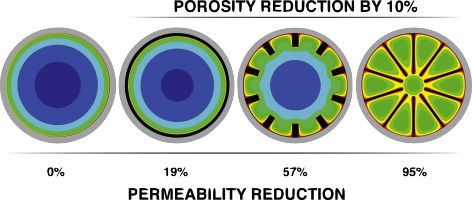
Graphical Abstract
28. Dobson, PF, TA Ghezzehei, PJ Cook, JA Rodríguez, L Villalba, R de la Garza,
Heterogeneous seepage at the Nopal I natural analogue site, Chihuahua, Mexico
Hydrogeology Journal, 20(1): 155-166, 2012.
Heterogeneous seepage at the Nopal I natural analogue site, Chihuahua, Mexico
Hydrogeology Journal, 20(1): 155-166, 2012.
Abstract:
A study of seepage occurring in an adit at the Nopal I uranium mine in Chihuahua, Mexico, was conducted as part of an integrated natural analogue study to evaluate the effects of infiltration and seepage on the mobilization and transport of radionuclides. An instrumented seepage collection system and local automated weather station permit direct correlation between local precipitation events and seepage. Field observations recorded between April 2005 and December 2006 indicate that seepage is highly heterogeneous with respect to time, location, and quantity. Seepage, precipitation, and fracture data were used to test two hypotheses: (1) that fast flow seepage is triggered by large precipitation events, and (2) that an increased abundance of fractures and/or fracture intersections leads to higher seepage volumes. A few zones in the back adit recorded elevated seepage volumes immediately following large (>20 mm/day) precipitation events, with transit times of less than 4 h through the 8-m thick rock mass. In most locations, there is a 1–6 month time lag between the onset of the rainy season and seepage, with longer times observed for the front adit. There is a less clear-cut relation between fracture abundance and seepage volume; processes such as evaporation and surface flow along the ceiling may also influence seepage.
27. Ghezzehei, TA
Soil Structure
in Handbook of Soil Sciences: Vol. 1 Properties and Processes (2nd Ed)
P.M. Huang, Y. Li, M.E. Sumner (Eds.), CRC Press, Boca Raton, Fla., 2012.
Soil Structure
in Handbook of Soil Sciences: Vol. 1 Properties and Processes (2nd Ed)
P.M. Huang, Y. Li, M.E. Sumner (Eds.), CRC Press, Boca Raton, Fla., 2012.

26. ***Ghebrenugus, T and TA Ghezzehei
An Index for Degree of Hysteresis in Water Retention
Soil Science Society of America Journal, 75:2122-2127, 2011.
An Index for Degree of Hysteresis in Water Retention
Soil Science Society of America Journal, 75:2122-2127, 2011.
Abstract:
Direct characterization of hysteresis in water retention (WR) is typically cumbersome and time consuming. Thus, such data are scarce, and even when available are typically ignored in unsaturated flow modeling. One reason for disregard of this ubiquitous and significant feature of WR is lack of a universally applicable index for the degree of hysteresis that allows a priori assessment of its effect on flow. In this note we show that the mismatch between the hydraulic capacity functions of the primary drainage and imbibition curves can serve as generalized index for degree of hysteresis (H). Moreover, we showed that hysteresis indices of a broad range of soils are linearly related with the natural-logarithm of the van Genuchten n parameter (r2 = 0.73). This model allows predicting the degree of hysteresis and the missing hysteresis branch using only wetting or drying water retention data. The robustness of the proposed index was illustrated by comparing it with error in simulated moisture redistribution in a horizontal column that arises from ignoring hysteresis.
25. ***Gebrenugus, T , TA Ghezzehei and M Tuller, and
Physico-chemical Controls on Initiation and Evolution of Desiccation Cracks in Bentonite-Sand Mixtures: X-ray Imaging and Stochastic Modeling
Journal of Contaminant Hydrology, 126:100-112, 2011.
Physico-chemical Controls on Initiation and Evolution of Desiccation Cracks in Bentonite-Sand Mixtures: X-ray Imaging and Stochastic Modeling
Journal of Contaminant Hydrology, 126:100-112, 2011.
Abstract:
The shrink-swell behavior of active clays in response to changes in physicochemical conditions creates great challenges for construction of geotechnical barriers for hazardous waste isolation, and is of significant importance for management of agricultural and natural resources. Initiation and evolution of desiccation cracks in active clays are strongly dependent on physicochemical initial and boundary conditions. To investigate effects of bentonite content (20, 40, 60%), pore fluid chemistry (0.05 and 0.5 M NaCl) and drying rates (40 and 60 oC) on cracking behavior, well-controlled dehydration experiments were conducted and X-ray Computed Tomography (CT) was applied to visualize and quantify geometrical features of evolving crack networks. A stochastic model based on the Fokker-Plank equation was adopted to describe the evolution of crack aperture distributions (CAD) and to assess the impact of physicochemical factors on cracking behavior. Analyses of crack porosity and crack specific surface area showed that both clay content and temperature had larger impact on cracking than pore fluid concentration. More cracks formed at high bentonite contents (40 and 60%) and at high drying rate (60 oC). The drift, diffusion and source terms derived from stochastic analysis indicated that evaporative demand had greater influence on the dynamics of the CAD than solution chemistry.
24. **Aravena, JE, M. Berli, T. A. Ghezzehei and S. W. Tyler
Effects of root-induced compaction on rhizosphere hydraulic properties--x-ray micro-tomography imaging and numerical simulations
Enviornmental Science and Technology, 45:425-431, 2011.
Effects of root-induced compaction on rhizosphere hydraulic properties--x-ray micro-tomography imaging and numerical simulations
Enviornmental Science and Technology, 45:425-431, 2011.
Abstract:Soil compaction represents one of the most ubiquitous environmental impacts of human development, decreasing bulk-scale soil porosity and hydraulic conductivity, thereby reducing soil productivity and fertility. At the aggregate-scale however, this study shows that natural root-induced compaction increases contact areas between aggregates, leading to an increase in unsaturated hydraulic conductivity of the soils adjacent to the roots. Contrary to intuition, water flow may therefore be locally enhanced due to root-induced compaction. This study investigates these processes by using recent advances in X-ray microtomography (XMT) imaging and numerical water flow modeling to show evolution in interaggregate contact and its implications for water flow between aggregates under partially saturated conditions. Numerical modeling showed that the effective hydraulic conductivity of a pair of aggregates undergoing uniaxial deformation increased following a nonlinear relationship as the interaggregate contact area increased due to increasing aggregate deformation. Numerical modeling using actual XMT images of aggregated soil around a root surrogate demonstrated how root-induced deformation increases unsaturated water flow toward the root, providing insight into the growth, function, and water uptake patterns of roots in natural soils.
23. Ghezzehei, T.A, and T.J. Kneafsey
Measurements of the Capillary Pressure-Saturation Relationship of Methane Hydrate Bearing Sediments
Offshore Technology Conference, Paper Number 20550-MS Houston, Texas, USA, 3-6 May, 2010.
Measurements of the Capillary Pressure-Saturation Relationship of Methane Hydrate Bearing Sediments
Offshore Technology Conference, Paper Number 20550-MS Houston, Texas, USA, 3-6 May, 2010.
Abstract: Capillary pressure is a function of the medium (wettability, geometry) and the saturations of all phases (e.g. gas, hydrate, water) in the pore space. The presence of hydrate alters the geometry of the pore space, changing the capillary pressure-saturation relationship from the hydrate-free condition. Understanding the capillary pressure-saturation relationship of hydrate-bearing media is important for modeling the flow of gas and water through that medium, and predicting natural gas production from hydrate-bearing reservoirs. We have developed a method for measuring the capillary pressure-saturation relationship in methane hydrate-bearing sand, and our measurements and modeling aid in understanding the behavior of the gas and water in hydrate-bearing sediment. Our experiments involve hydrate formation in unsaturated sand, saturating the sample, followed by step-wise drainage from full water saturation to residual water saturation while measuring the pressure difference between the water and gas phases. During drainage, a number of intermediate static equilibrium conditions were established during which flow was discontinued. The static equilibrium observations provide water saturation vs. capillary pressure relations. For selected samples, drainage was followed by step-wise imbibition to full saturation.
22. Berli, M, A Carminati, TA Ghezzehei and D Or
Evolution of unsaturated hydraulic conductivity of aggregated soils due to compressive forces
Water Resources Research, doi:10.1029/2007WR006501, 2008.
Evolution of unsaturated hydraulic conductivity of aggregated soils due to compressive forces
Water Resources Research, doi:10.1029/2007WR006501, 2008.
Abstract: Prediction of water flow and transport processes in soils susceptible to structural alteration such as compaction of tilled agricultural lands or newly constructed landfills rely on accurate description of changes in soil unsaturated hydraulic conductivity. Recent studies have documented the critical impact of aggregate contact characteristics on water flow rates and pathways in unsaturated aggregated soils. We developed an analytical model for aggregate contact size evolution as a basis for quantifying effects of compression on saturated and unsaturated hydraulic conductivity of aggregated soil. Relating confined one-dimensional sample strain with aggregate deformation facilitates prediction of the increase in interaggregate contact area and concurrent decrease in macropore size with degree of sample compression. The hydrologic component of the model predicts unsaturated hydraulic conductivity of a pack of idealized aggregates (spheres) on the basis of contact size and saturation conditions under prescribed sample deformation. Calculated contact areas and hydraulic conductivity for pairs of aggregates agreed surprisingly well with measured values, determined from compaction experiments employing neutron and X-ray-radiography and image analysis. Model calculations for a unit cell of uniform spherical aggregates in cubic packing were able to mimic some of the differences in saturated and unsaturated hydraulic conductivity observed for aggregates and bulk soil.
21. Dobson, PF, P Goodell, M Fayek, TA Ghezzehei, F Melchor, M Murrell, I Reyes, R de la Garza, and A Simmons
Stratigraphy of the PB-1 well, Nopal I uranium deposit, Sierra Peña Blanca, Chihuahua, Mexico
International Geology Review, 50(11):959-974, 2008.
Stratigraphy of the PB-1 well, Nopal I uranium deposit, Sierra Peña Blanca, Chihuahua, Mexico
International Geology Review, 50(11):959-974, 2008.
Abstract: The Nopal I site in the Pena Blanca uranium district. has a number of geologic and hydrologic similarities to the proposed high-level radioactive waste repository at Yucca Mountain, making it a useful analogue to evaluate process models for radionuclide transport. The PB-1 well was drilled in 2003 at the Nopal I uranium deposit as part of a DOE-sponsored natural analogue study to constrain processes affecting radionuclide transport.The well penetrates through the Tertiary Volcanic section down to Cretaceous limestone and intersects the regional aquifer system. The well, drilled along the margin of the Nopal I ore body, was continuously cored to a depth of 250 in, thus providing an Opportunity to document the local stratigraphy.
Detailed observations of these units were afforded through petrographic description and rock-property measurements of the core, together with geophysical logs of the welt. The upper unit encountered in the PB-1. well is the Nopal Formation, a densely welded, crystal-rich, chlorite ash-flow tuff. This cored section is highly altered and devitrified, with kaolinite, quartz, chlorite, and montmorillonite replacing feldspars and much of the groundmass. Breccia zones within the tuff contain fracture fillings of hematite, limonite, goethite, jarosite, and opal. A zone of intense clay alteration, encountered in the depth interval 17.45-22.30 m, was interpreted to represent the basal vitrophyre Of this unit. Underlying the Nopal Formation is the Coloradas Formation, which consists of a welded lithic-rich rhyolitic ash-flow tuff. The cored section of his unit has undergone devitrification and oxidation, and has a similar alteration mineralogy to that observed in the Nopal tuff. A sharp contact between the Coloradas tuff and the underlying Pozos Formation was observed at a depth of 1.36.38 m. The Pozos Formation consists of poorly sorted conglomerate containing clasts of subangular to subrounded fragments of volcanic rocks, limestone, and chert. Three thin (2-6 m) intervals of intercalated pumiceous tuffs tire present within this unit. The Contact between the Pozos Formation and the underlying Cretaceous limestone basement was encountered at a depth of 244.40 m.
The water table is located at a depth of similar to 223 m. Several zones with elevated radioactivity in the PB-1 core occur above the current water table. These zones may be associated with changes in redox conditions that could have resulted in the precipitation of uraninite from downward-flowing waters transporting U from the overlying Nopal deposit. All of the intersected units have low (typically sub-millidarcy) matrix permeability, thus fluid How in this area is dominated by fracture flow. These stratigraphic and rock-properly observations call be used to constrain flow and transport models for the Pena Blanca natural analogue.
20. Ghezzehei, TA
Errors in determination of soil water content using time-domain reflectometry caused by compaction around wave guides
Water Resources Research, 44, W08451, 2008.
Errors in determination of soil water content using time-domain reflectometry caused by compaction around wave guides
Water Resources Research, 44, W08451, 2008.
Abstract: Application of time domain reflectometry (TDR) in soil hydrology often involves the conversion of TDR-measured dielectric permittivity to water content using universal calibration equations (empirical or physically based). Deviations of soil-specific calibrations from the universal calibrations have been noted and are usually attributed to peculiar composition of soil constituents, such as high content of clay and/or organic matter. Although it is recognized that soil disturbance by TDR waveguides may have impact on measurement errors, to our knowledge, there has not been any quantification of this effect. In this paper, we introduce a method that estimates this error by combining two models: one that describes soil compaction around cylindrical objects and another that translates change in bulk density to evolution of soil water retention characteristics. Our analysis indicates that the compaction pattern depends on the mechanical properties of the soil at the time of installation. The relative error in water content measurement depends on the compaction pattern as well as the water content and water retention properties of the soil. Illustrative calculations based on measured soil mechanical and hydrologic properties from the literature indicate that the measurement errors of using a standard three-prong TDR waveguide could be up to 10%. We also show that the error scales linearly with the ratio of rod radius to the interradius spacing.
19. Salve, R, TA Ghezzehei, R Jones
Infiltration into fractured bedrock
Water Resources Research, 44(1): W01434, 2008.
Infiltration into fractured bedrock
Water Resources Research, 44(1): W01434, 2008.
Abstract: One potential consequence of global climate change and rapid changes in land use is an increased risk of flooding. Proper understanding of floodwater infiltration thus becomes a crucial component of our preparedness to meet the environmental challenges of projected climate change. In this paper, we present the results of a long- term infiltration experiment performed on fractured ash flow tuff. Water was released from a 3 x 4 m(2) infiltration plot (divided into 12 square subplots) with a head of similar to 0.04 m, over a period of similar to 800 days. This experiment revealed peculiar infiltration patterns not amenable to current infiltration models, which were originally developed for infiltration into soils over a short duration. In particular, we observed that in part of the infiltration plot, the infiltration rate abruptly increased a few weeks into the infiltration tests. We suggest that these anomalies result from increases in fracture permeability during infiltration, which may be caused by swelling of clay fillings and/or erosion of infill debris. Interaction of the infiltration water with subsurface natural cavities (lithophysal cavities) could also contribute to such anomalies. This paper provides a conceptual model that partly describes the observed infiltration patterns in fractured rock and highlights some of the pitfalls associated with direct extension of soil infiltration models to fractured rock over a long period.
18. Ghezzehei, TA
Book review: "Clay Swelling and Colloid Stability" by Martin Smalley
Soil Science Society of America Journal, 72(1):277, 2008.
Book review: "Clay Swelling and Colloid Stability" by Martin Smalley
Soil Science Society of America Journal, 72(1):277, 2008.
17. Ghezzehei, TA, T. J. Kneafsey, G. W. Su
Correspondence of the Gardner and van Genuchten-Mualem relative permeability function parameters
Water Resources Research, 43 (10):W10417, 2007.
Correspondence of the Gardner and van Genuchten-Mualem relative permeability function parameters
Water Resources Research, 43 (10):W10417, 2007.
Abstract:The Gardner and van Genuchten-Mualem models of relative permeability are widely used in analytical and numerical solutions to flow problems, respectively. Comparison of analytical and numerical solutions therefore requires defining some correspondence between the Gardner and van Genuchten-Mualem models. In this paper, we introduce generalized conversion formulae that reconcile these two models in the midrange of saturation. In general, we find that the Gardner parameter a G is related to the van Genuchten parameters alpha(vG) and n as alpha(G) approximate to 1.3 alpha(vG) n. The performance of the proposed conversion formulae is poor when n is much smaller than 2.
16. Cortis A., and TA Ghezzehei
On the transport of emulsion in porous media
Journal of Colloids and Interface Science, 313 (1):1-4, 2007
On the transport of emulsion in porous media
Journal of Colloids and Interface Science, 313 (1):1-4, 2007
Abstract: Emulsions appear in many subsurface applications including bioremediation, surfactant-enhanced remediation, and enhanced oil-recovery. Modeling emulsion transport in porous media is particularly challenging because the rheological and physical properties of emulsions are different from averages of the components. Current modeling approaches are based on filtration theories, which are not suited to adequately address the pore-scale permeability fluctuations and reduction of absolute permeability that are often encountered during emulsion transport. In this communication, we introduce a continuous time random walk based alternative approach that captures these unique features of emulsion transport. Calculations based on the proposed approach resulted in excellent match with experimental observations of emulsion breakthrough from the literature. Specifically, the new approach explains the slow late-time tailing behavior that could not be fitted using the standard approach. The theory presented in this paper also provides an important stepping stone toward a generalized self-consistent modeling of multiphase flow.
Graphical Abstract: A novel CTRW based model for emulsion transport provides an excellent match to the experimental oil breakthrough curve of Coulibaly et al. [K.M. Coulibaly, R.C. Borden, J. Control. Hydrol. 71 (1-4) (2004) 219-237].
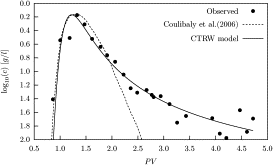
Graphical Abstract: A novel CTRW based model for emulsion transport provides an excellent match to the experimental oil breakthrough curve of Coulibaly et al. [K.M. Coulibaly, R.C. Borden, J. Control. Hydrol. 71 (1-4) (2004) 219-237].
15. Or, D and TA Ghezzehei
Velocity and geometry of liquid bridges travelling in fractures
Transport in Porous Media, 68 (1):129-151, 2007.
Velocity and geometry of liquid bridges travelling in fractures
Transport in Porous Media, 68 (1):129-151, 2007.
Abstract: Interplay between capillary, gravity and viscous forces in unsaturated fractures gives rise to a range of complex flow phenomena. Evidence of highly inter- mittent fluxes, preferential and sustainable flow pathways lead to potentially signifi- cant flow focusing of concern for regulatory and management of water resources in fractured rock formations. In previous work [Ghezzehei TA,Or D.: Water Resour. Res. In Review(2005)] we developed mechanistic models for formation, growth and detachment of liquid bridges in geometrical irregularities within fractures. Such dis- crete and intermittent flows present a challenge to standard continuum theories. Our focus here is on predicting travel velocities of detached liquid elements and their interactions with fracture walls. The scaling relationships proposed by Podgorski et al. [Podgorski, T., et al.: Phys. Rev. Lett. 8703(3), 6102-NIL_95 (2001)] provide a gen- eral framework for processes affecting travel velocities of discrete liquid elements in fractures, tubes, and in coarse porous media. Comparison of travel velocity and distance by discrete bridges relative to equivalent continuous film flow reveal signifi- cantly faster and considerably larger distances traversed by liquid bridges relative to liquid films. Coalescence and interactions between liquid bridges result in complex patterns of travel times and distances. Mass loss on rough fracture surfaces shortens travel distances of an element; however, results show that such retardation provides new opportunities for coalescence of subsequent liquid elements traveling along the same path, resulting in mass accumulation and formation of larger liquid elements traveling larger distances relative to smooth fracture surfaces. Such flow focusing pro- cesses may be amplified considering a population of liquid bridges within a fracture plane and mass accumulation in fracture intersections.
14. Or, D and TA Ghezzehei
Comment on "Computer simulation of two-phase immiscible fluid motion in unsaturated complex fractures using a volume of fluid method" by H. Huang, P. Meakin, and M. Liu
Water Resources Research, 42 (7): W07601. 2006.
Comment on "Computer simulation of two-phase immiscible fluid motion in unsaturated complex fractures using a volume of fluid method" by H. Huang, P. Meakin, and M. Liu
Water Resources Research, 42 (7): W07601. 2006.
Graphical Abstract: Comparison of the steady state sliding velocity for different droplet lengths predicted by VOF method [Huang et al., 2005], analytical solution Dragila and Weisbrod [2003] given in equation, and analytical solution adjusted for effects of dynamic contact angle and trailing film (this comment) equation (4).
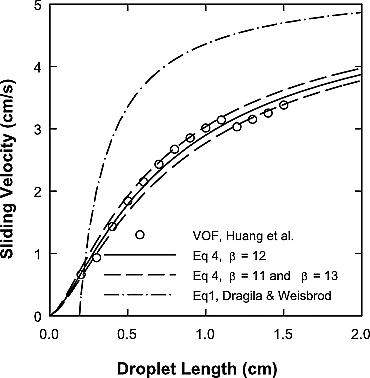
13. Ghezzehei, TA and D Or
Liquid fragmentation and intermittent flow regimes in unsaturated fractures
Water Resources Research, 41:W12406. 2005.
Liquid fragmentation and intermittent flow regimes in unsaturated fractures
Water Resources Research, 41:W12406. 2005.
Abstract: Flow diversion around subsurface cavities in unsaturated fractured media is important to numerous environmental and engineering applications. This paper provides analytical solutions to partial and complete flow diversion around cavities intersected by fractures under steady state conditions. It is focused on a typical trifracture junction located upstream from a cavity surface. Fractures are modeled as two-dimensional porous media with an exponential relationship between the capillary pressure and unsaturated hydraulic conductivity. The solutions show that the vertical distance between the fracture end and the nearest junction (Z) and the slope of the unsaturated hydraulic conductivity (α) are by far the most important determinants of flow diversion. In fact, the product of Z and α enters the threshold flux and liquid entry flux equations as a dimensionless sorptive length (s). This relationship between Z and α is shown to have important implications for uncertainty and scalability of calibrated model parameters. The solutions given in this paper are expected to be directly applicable to cavities on the order of the fracture spacing.
12. Ghezzehei, TA
Flow diversion around cavities in fractured media
Water Resources Research, 41 (11): W11501. 2005.
Flow diversion around cavities in fractured media
Water Resources Research, 41 (11): W11501. 2005.
Abstract: Flow diversion around subsurface cavities in unsaturated fractured media is important to numerous environmental and engineering applications. This paper provides analytical solutions to partial and complete flow diversion around cavities intersected by fractures under steady state conditions. It is focused on a typical trifracture junction located upstream from a cavity surface. Fractures are modeled as two-dimensional porous media with an exponential relationship between the capillary pressure and unsaturated hydraulic conductivity. The solutions show that the vertical distance between the fracture end and the nearest junction (Z) and the slope of the unsaturated hydraulic conductivity (α) are by far the most important determinants of flow diversion. In fact, the product of Z and α enters the threshold flux and liquid entry flux equations as a dimensionless sorptive length (s). This relationship between Z and α is shown to have important implications for uncertainty and scalability of calibrated model parameters. The solutions given in this paper are expected to be directly applicable to cavities on the order of the fracture spacing.
11. Ghezzehei, TA
Constraints for flow regimes on smooth fracture surfaces
Water Resources Research, 40 (11): W11503. 2004.
Constraints for flow regimes on smooth fracture surfaces
Water Resources Research, 40 (11): W11503. 2004.
Abstract: In recent years, significant advances have been made in our understanding of the complex flow processes in individual fractures, aided by flow visualization experiments and conceptual modeling efforts. These advances have led to the recognition of several flow regimes in unsaturated individual fractures subjected to different initial and boundary conditions. For an idealized smooth fracture surface the most important regimes are film flow, rivulet flow, and sliding of droplets. The existence of such significantly dissimilar flow regimes has been a major hindrance in the development of self-consistent conceptual models of flow for single fracture surfaces that encompass all the flow regimes. The objective of this study is to delineate the existence of the different flow regimes in individual fracture surfaces. For steady state flow conditions, we developed physical constraints on the different flow regimes that satisfy minimum energy configurations, which enabled us to segregate the wide range of fracture flux (volumetric flow rate per fracture width) into several flow regimes. These are, in increasing order of flow rate, flow of adsorbed films, flow of sliding drops, rivulet flow, stable film flow, and unstable (turbulent) film flow. The scope of this study is limited to wide-aperture smooth fractures with the flow on the opposing sides of fracture being independent.
10. Ghezzehei, TA, R Trautz, S. Finsterle, P. J. Cook, and CF Ahlers
Modeling coupled evaporation and seepage in ventilated cavities
Vadose Zone Journal, 3: 806-818. 2004.
Modeling coupled evaporation and seepage in ventilated cavities
Vadose Zone Journal, 3: 806-818. 2004.
Abstract: Cavities excavated in unsaturated geological formations are important to activities such as nuclear waste disposal and mining. Such cavities provide a unique setting for simultaneous occurrence of seepage and evaporation. Previously, inverse numerical modeling of field liquid-release tests and associated seepage into cavities were used to provide seepage-related large-scale formation properties, ignoring the impact of evaporation. The applicability of such models was limited to the narrow range of ventilation conditions under which the models were calibrated. The objective of this study was to alleviate this limitation by incorporating evaporation into the seepage models. We modeled evaporation as an isothermal vapor diffusion process. The semiphysical model accounts for the relative humidity (RH), temperature, and ventilation conditions of the cavities. The evaporation boundary layer thickness (BLT) over which diffusion occurs was estimated by calibration against free-water evaporation data collected inside the experimental cavities. The estimated values of BLT were 5 to 7 mm for the open underground drifts and 20 mm for niches closed off by bulkheads. Compared with previous models that neglected the effect of evaporation, this new approach showed significant improvement in capturing seepage fluctuations into open cavities of low RH. At high relative-humidity values (>85%), the effect of evaporation on seepage was very small.
09. Ghezzehei, TA and D Or
Stress-induced volume reduction of isolated pores in wet soil
Water Resources Research, 39 (3): 1067, 2003.
Correction: Water Resources Research, 39(5):1124, 2003.
Stress-induced volume reduction of isolated pores in wet soil
Water Resources Research, 39 (3): 1067, 2003.
Correction: Water Resources Research, 39(5):1124, 2003.
Abstract: This study deals with deformation of small pores in wet soils of relatively high bulk density such as in the final settlement phase of tilled or disturbed soils. Pore deformation was modeled by volume reduction of spherical voids embedded in a homogenous soil matrix. External constant stress and overburden were considered as steady stresses because the change in interaggregate contact stress under overburden is slow compared to the associated strain rate. In contrast, stress due to passage of farm implements was considered as transient because the rate of change of interaggregate stress is comparable with the strain rate. Rheological behavior of the soil matrix under steady and transient stresses was obtained from independent rheological measurements. Experimental data from the literature were used to illustrate the model. Model predictions of relative density compared favorably with experimental data for constant stress application as well as for constant strain rate experiments. Results showed that the rate of densification decreased as the relative density approached unity (complete pore closure) and the relative stress required for driving densification increased exponentially with increasing relative density.
08. Ghezzehei, TA and D Or
Pore space dynamics in soil aggregate bed under steady external load
Soil Science Society of America Journal, 67(1): 12-19. 2003
Pore space dynamics in soil aggregate bed under steady external load
Soil Science Society of America Journal, 67(1): 12-19. 2003
Abstract: The loose and fragmented soil structure that results from tillage operations provides favorable physical conditions for plant growth. This desirable state is structurally unstable and deteriorates with time because of overburden, external stresses, and capillary forces. The objective of this study was to model these structural changes by coupling soil intrinsic rheological properties with geometry and arrangement of aggregates represented as monosized spheres. Calculations of interaggregate stresses and strains, and associated changes in density and porosity, were performed for a rhombohedral unit cell. Soil rheological properties determined by application of steady shear stress were used for calculations of strains under steady interaggregate stresses. The models developed herein correspond to the initial stage of deformation when discrete aggregates exist. At strains exceeding 0.12 the interaggregate voids are isolated and the current model no longer applies and an alternative approach is presented elsewhere. Unit cell calculations were up scaled to an aggregate-bed scale by considering a one-dimensional stack of unit cells, which allows only vertical stress transmission. The stress acting at an interaggregate contact is fully accommodated (dissipated) by viscous flow when it exceeds the yield stress (strength) of the aggregates. The stress is fully transmitted to subsequent unit cells when it is less than the yield stress. Plausibility of the models was demonstrated by illustrative examples that highlight the different features of the models. The results were in qualitative agreement with observations from the literature for deformation of either loose structure, and for highly dense cases close to maximal bulk density.
07. Leij, F. J., TA Ghezzehei, and D Or
Analytical models for soil pore-size distribution after tillage
Soil Science Society of America Journal, 66(4): 1104-1114. 2002
Analytical models for soil pore-size distribution after tillage
Soil Science Society of America Journal, 66(4): 1104-1114. 2002
Abstract: Tillage causes soil fragmentation thereby increasing the proportion of interaggregate (structural) pore space. The resulting tilled layer tends to be structurally unstable as manifested by a gradual decrease in interaggregate porosity until a new equilibrium has been reached between external loads and internal capillary forces at a rate governed by the soil rheological properties. The soil pore-size distribution (PSD) will change accordingly with time. We have previously applied the Fokker-Planck equation (FPE) to describe the evolution of the PSD as the result of drift, dispersion, and degradation processes that affect the pore space in unstable soils. In this study, we provide closed-form solutions for PSD evolution, which can be used to predict temporal behavior of unsaturated soil hydraulic properties. Solutions and moments of the PSD were obtained in case: (i) drift and degradation coefficients depend on time and the dispersivity is constant and (ii) drift and dispersivity are also linearly related to pore size. Both solutions can model the reduction in pore size during the growing season while the second solution can account for a reduction in the dispersion of the PSD. The solutions for PSD were plotted for a mathematically convenient expression for the drift and degradation coefficients and for an expression derived from a model for soil aggregate coalescence. Experimental data on the settlement of a Millville (coarse-silty, carbonatic, mesic Typic Haploxeroll) silt loam during wetting and drying cycles were used to determine time-dependent drift and degradation coefficients according to this coalescence model. The solution for the PSD was used to independently predict the water retention curve, which exhibited a satisfactory agreement with experimental retention data at the end of two drying cycles.
06. Leij, F. J., TA Ghezzehei, and D Or
Modeling the dynamics of the soil pore-size distribution
Soil and Tillage Research, 64(1-2): 61-78. 2002
Modeling the dynamics of the soil pore-size distribution
Soil and Tillage Research, 64(1-2): 61-78. 2002
Abstract: Soil tillage often results in a structurally unstable soil layer with an elevated inter-aggregate porosity that is gradually decreased by the interplay of capillary and rheological processes. We have previously proposed to describe the evolution of the pore-size distribution (PSD) with the Fokker–Planck equation (FPE). The coefficients of this equation quantify the drift, dispersion, and degradation processes acting upon the PSD. An analytical solution for the PSD is presented for the case where drift and degradation coefficients depend on time, and the dispersion coefficient is proportional to the drift coefficient. These coefficients can be estimated from independent measurements of the PSD or (surrogate) water retention data or from mechanistic models. In this paper, we illustrate the application of the pore-size evolution model for: (i) a generic drift coefficient, (ii) static water retention data for soils under different tillage regimes, and (iii) dynamic hydraulic data for a soil subject to a sequence of wetting and drying cycles. These applications show the viability of our approach to model pore-size evolution. However, the development and application of the model is hampered by a lack of definitive data on soil structural and hydraulic dynamics.
05. Or, D and TA Ghezzehei
Modeling post-tillage structural dynamics in aggregated soils: a review
Soil and Tillage Research, 64(1-2): 41-59. 2002
Modeling post-tillage structural dynamics in aggregated soils: a review
Soil and Tillage Research, 64(1-2): 41-59. 2002
Abstract: Tillage modifies the soil structure to create conditions favorable for plant growth. However, the resulting loose structure is susceptible to collapse by internal capillary forces and external compactive stresses with concurrent changes in soil hydraulic properties. Presently, limited understanding of these complex processes often leads to consideration of the soil plow-layer as a static porous medium. Our objective is to provide a review of recent progress in modeling soil structural dynamics at the pore-scale, based on soil mechanical and rheological properties. The basic geometrical framework of the models was a cubic arrangement of monosized spherical aggregates (other arrangements are discussed). The process of soil aggregate rejoining by capillary forces was modeled by considering the rate of energy dissipation due to viscous deformation of wet soil, and corresponding energy release due to reconfiguration of water capillary menisci. The model was complemented by independent rheological characterization of soil that provides control on the rate as well as the onset and termination of aggregate coalescence. The model was also adapted for consideration of steady stress (such as overburden) acting upon the unit cells. Unlike steady stress, transient stress (such as traffic) is applied for too short of a period to allow for total energy dissipation by viscous deformation. Hence, a portion of the deformation is elastic (with a recoverable portion of the applied energy). Rheological characterization under transient (oscillatory) stress provided coupled elastic and viscous properties under several loading frequencies. Effects of transient stresses on the geometrical model were modeled by considering a combination of (i) Hertzian-type elastic strain and (ii) viscous flow of soil at the contacts. Application of the models is demonstrated using illustrative examples and rheological measurements of Millville silt loam soil. Finally, we provide an outlook for upscaling the unit cell results to an aggregate bed scale.
04. Ghezzehei, TA and D Or
Rheological properties of wet soils and clays under steady and oscillatory stresses
Soil Science Society of America Journal, 65(3): 624-637. 2001
Rheological properties of wet soils and clays under steady and oscillatory stresses
Soil Science Society of America Journal, 65(3): 624-637. 2001
Abstract: Tilled agricultural soils are in a constant state of change induced by variations in soil strength due to wetting and drying and compaction by farm implements. Changes in soil structure affect many hydraulic and transport properties; hence their quantification is critical for accurate hydrological and environmental modeling. This study highlights the role of soil rheology in determining time-dependent stress-strain relationships that are essential for prediction and analysis of structural changes in soils. The primary objectives of this study were (i) to extend a previously proposed aggregate-pair model to prediction of compaction under external steady or transient stresses and (ii) to provide experimentally determined rheological information for the above models. Rheological properties of soils and clay minerals were measured with a rotational rheometer with parallel-plate sensors. These measurements, under controlled steady shear stress application, have shown that wet soils have viscoplastic behavior with well-defined yield stress and nearly constant plastic viscosity. In contrast, rapid transient loading (e.g., passage of a tractor) is often too short for complete viscous dissipation of applied stress, resulting in an elastic (recoverable) component of deformation (viscoelastic behavior). Measured viscoelastic properties were expressed by complex viscosity and shear modulus whose components denote viscous energy dissipation, and energy storage (elastic). Results show that for low water contents and fast loading (tractor speed), the elastic component of deformation increases, whereas with higher water contents, viscosity and shear modulus decrease. Steady and oscillatory stress application to an aggregate pair model illustrates potential use of rheological properties towards obtaining predictions of strains in soils.
03. Or, D, F. J. Leij, V. Snyder, and TA Ghezzehei
Stochastic model for post tillage soil pore size evolution
Water Resources Research, 36(7): 1641-1652. 2000
Stochastic model for post tillage soil pore size evolution
Water Resources Research, 36(7): 1641-1652. 2000
Abstract: Tillage operations disrupt surface layers of agricultural soils, creating a loosened structure with a substantial proportion of interaggregate porosity that enhances liquid and gaseous exchange properties favorable for plant growth. Unfortunately, such desirable soil tilth is structurally unstable and is susceptible to change by subsequent wetting and drying processes and other mechanical stresses that reduce total porosity and modify pore size distribution (PSD). Ability to model posttillage dynamics of soil pore space and concurrent changes in hydraulic properties is important for realistic predictions of transport processes through this surface layer. We propose a stochastic modeling framework that couples the probabilistic nature of pore space distributions with physically based soil deformation models using the Fokker-Planck equation (FPE) formalism. Three important features of soil pore space evolution are addressed: (1) reduction of the total porosity, (2) reduction of mean pore radius, and (3) changes in the variance of the PSD. The proposed framework may be used to provide input to hydrological models concerning temporal variations in near-surface soil hydraulic properties. In a preliminary investigation of this approach we link a previously proposed mechanistic model of soil aggregate coalescence to the stochastic FPE framework to determine the FPE coefficients. An illustrative example is presented which describes changes in interaggregate pore size due to wetting-drying cycles and the resulting effects on dynamics of the soil water characteristic curve and hydraulic conductivity functions.
02. Or, D and TA Ghezzehei
Dripping into cavities from unsaturated fractures under evaporative conditions
Water Resources Research, 36(2): 381-393. 2000
Dripping into cavities from unsaturated fractures under evaporative conditions
Water Resources Research, 36(2): 381-393. 2000
Abstract: Water dripping into subterranean cavities within fractured porous media is studied in order to improve estimates of dripping rates, drop sizes, and chemical composition of droplets that could affect long-term integrity of waste disposal canisters placed in caverns. Steady state liquid flux in fracture surfaces supported by flow in partially liquid-filled grooves and liquid films in adjacent planes was calculated as a function of the matric potential (vapor pressure) of the fracture. At an intersection of a vertical fracture with a wider cavity the liquid flux feeds a growing pendant drop that eventually detaches. Equilibrium state size and approximate shape of liquid drops suspended from the cavity ceiling were determined from lateral and vertical force balance considering capillarity, gravity, and hydrostatic pressure. A one-dimensional, viscous extension model with appropriate gravitational and surface tension components was employed to determine dripping rate from specified fracture roughness geometry as a function of matric potential (flux). The effect of evaporation from drop surface during drop formation was incorporated; the resulting alterations in drop volume, dripping rate, and drop solute concentration were determined. To facilitate experimental testing of the proposed model, a decoupled solution that considers independently controlled flux and evaporation is presented. Under evaporative conditions, dripping in finite period is possible only when volumetric flux exceeds evaporative demand. Calculations indicate that dripping rate and solute concentration are extremely sensitive to ambient matric potential. The results of this work may be extended to study other phenomena including formation and growth of stalactites and rivulet flow in cave ceilings.
01. Ghezzehei, TA and D Or
Dynamics of soil aggregate coalescence governed by capillary and tillage processes
Water Resources Research, 36(2): 367-379. 2000
Dynamics of soil aggregate coalescence governed by capillary and tillage processes
Water Resources Research, 36(2): 367-379. 2000
Abstract: The desired soil structure following tillage of agricultural soils is often unstable and susceptible to coalescence of aggregates and reduction of interaggregate porosity due to wetting and drying cycles. This process of aggregate rejoining was modeled by equating the rate of work done by liquid-vapor menisci, to the rate of energy dissipation due to viscous deformation of a pair of spherical aggregates. The nonlinearity of wet soil viscous flow behavior was accounted for by introducing a Bingham rheological model. A natural outcome of the analysis was the formulation of a mathematical condition for the onset and termination of coalescence based on soil strength at specified water content. The condition states that sufficient energy in excess of soil strength (yield stress) must be available for coalescence to proceed. The rate of aggregate coalescence is proportional to available energy and is inversely related to the coefficient of plastic viscosity. Transport of wet soil to the periphery of the interaggregate contact by viscous flow leads to smoothing of the neck, resulting in pore closure, on the one hand, and restricting the minimum matric potential that can be achieved, on the other. The interplay between rheology and geometry prevent coalescence from proceeding indefinitely. Independently determined soil rheological properties were used to illustrate the use of the model. Coalescence under constant water content and during wetting-drying cycles was calculated. Comparison of data from experiments on one-dimensional, aggregate bed settlement has shown reasonable agreement with the model predictions.
AGU
AGU
Submitted for Review
In Preparation
**Albalasmeh, AA and TA Ghezzehei
Association of anionic extracellular polymers with Sand
Soil and Tillage Research
Peer-reviewed Major Reports
Ghezzehei, T. A., Liu, H.H.Calibrated Properties Model (Analysis and Model Report to Support the License Application for the Yucca Mountain Nuclear Waste Repository)
Bechtel SAIC, LLC., Las Vegas, Nevada. MDL-NBS-HS-000004 REV02 (2004).
Ghezzehei, T. A.
Integration between three-dimensional unsaturated zone flow, multiscale thermal-hydrologic, and drift seepage models
Bechtel SAIC, LLC. Berkeley Lab Report. LBID-2536 (2004).
Ghezzehei, T. A.
Using test data to reduce uncertainty in total system performance assessment seepage abstraction
Bechtel SAIC, LLC. Berkeley Lab Report. LBID-2529.(2004)
Finsterle, S., Ghezzehei, T. A., Trautz, R.C., Cook, P.
Seepage Calibration Model and Seepage Testing Data (Analysis and Model Report to Support the License Application for the Yucca Mountain Nuclear Waste Repository)
Bechtel SAIC, LLC., Las Vegas, Nevada. MDL-NBS-HS-000004 REV02. (2003).
Contributed Chapters in Books and Conference Proceedings
Berhe, A.A. and TA GhezzeheiBiogeochemical Feedbacks.
in Encyclopedia of Global Warming and Climate Change
S.G. Philander (ED), Sage Publications Inc, 2008.
Revised in 2nd Ed. (2012)
Berhe, A.A. and TA Ghezzehei
Climate Data and Sediment Records
in Encyclopedia of Global Warming and Climate Change,
S.G. Philander (ED), Sage Publications Inc, 2008.
Revised in 2nd Ed. (2012)
Cherubini, C., TA Ghezzehei, and GW Su
The drift shadow phenomenon in an unsaturated fractured environment
First European Conference on Unsaturated Soils, Paper No 106 Durham, UK,2-4 July, 2008.
Ghezzehei, T.A, P. F. Dobson, J. A. Rodriguez, and P. J. Cook
Infiltration and seepage through welded fractured tuff
International High Level Radioactive Waste Management Conference, 2006.
Su, GW, TJ Kneafsey, TA Ghezzehei, B. Marshall, and P. J. Cook
Field investigation of the drift shadow
International High Level Radioactive Waste Management Conference, 2006.
Paces, J., L. Neymark, TA Ghezzehei and PF Dobson
Testing the concept of drift shadow at Yucca Mountain, Nevada
International High Level Radioactive Waste Management Conference, 2006.
Ghezzehei, TA, RA. Trautz, and S. Finsterle
Evaluating the effectiveness of liquid diversion around an underground opening when evaporation is non- negligible
International TOUGH Symposium Proceedings, LBNL, Berkeley, Calif. 2004.
Ahlers, CF, TA Ghezzehei, and S. Finsterle
Development and testing of a method for efficient simulation of evaporation from a seepage face
International TOUGH Symposium Proceedings, LBNL, Berkeley, Calif. 2004.
Berli, M., TA Ghezzehei, and D Or
Modeling bulk soil compaction using a Rheologically-based pore closure model
in Environmental Geomechanics
Vulliet and Laloui (Eds.) Monte Verit, Switzerland, 2003.
Fedors, R, TA Ghezzehei, and D Or
Dripping into subterranean cavities from unsaturated fractures under ventilated conditions.
SEM Proceedings. Littleton, Colorado, 2000.
2013
Arnold, C.L., T.A. Ghezzehei, and , A.A. BerheInfluence of water potential on decomposition of soil organic matter in high elevation meadows
Abstract EP13C-0878 presented at 2012 Fall Meeting, AGU, San Francisco, Calif., 3-7 Dec.
Bogie, N A, R. Bayala, A. Burns, I. Diedhiou, T.A. Ghezzehei, and R. Dick
Crop Water Stress Reduction Due to The Effects of Native Woody Shrubs in the Peanut Basin, Senegal
Abstract H21F-1122 presented at 2012 Fall Meeting, AGU, San Francisco, Calif., 3-7 Dec.
Ghezzehei, T.A. and A.A. Albalasmeh
Radial reduction profile of root exudates facilitates water uptake
Abstract H51A-1180 presented at 2012 Fall Meeting, AGU, San Francisco, Calif., 3-7 Dec.
Arnold, C.L., A. A. Berhe, and T.A. Ghezzehei
Linking loss of water storage capacity in high elevation meadow soils to changes in soil structure and organic matter stock after extreme drought
AGU-Chapman Conference on Soil-mediated Drivers of Coupled Biogeochemical and Hydrological Processes, 21-24 Oct
Albalasmeh, A.A. and T.A. Ghezzehei
Implications of Radial Distribution of Organic Matter in the Rhizosphere to Root Water Uptake.
Abstract 292-8 presented at 2013 ASA-CSSA-SSSA Annual Meeting, Tampa, Florida 3-6 Nov.
Albalasmeh, A.A. and T.A. Ghezzehei
Soil aggregate formation: the role of wetting-drying cycles in the genesis of interparticle bonding
Abstract EGU2013-5969 presented at 2013 EGU general assembly, Vienna, Austria, 7-12 April.
Albalasmeh, A.A. and T.A. Ghezzehei
Rhizosphere water dynamics: role of exudates in mediating water retention and flow characteristics
Abstract EGU2013-5981 presented at 2013 EGU general assembly, Vienna, Austria, 7-12 April.
Albalasmeh, A.A., A.A. Berhe and T.A. Ghezzehei
Association mechanisms of sand with anionic extracellular polysaccharides (EPS)
Abstract EGU2013-956 presented at 2013 EGU general assembly, Vienna, Austria, 7-12 April.
Berhe, A.A., M. Kaiser, T.A. Ghezzehei, D. Myrold and M Kleber
Influence of calcium carbonate and charcoal application on aggregation processes and organic matter retention at the silt-size scale
Abstract EGU2013-7685 presented at 2013 EGU general assembly, Vienna, Austria, 7-12 April.
2012
Albalasmeh, A.A., J. Sweet, T. Gebrenegus, T.A. GhezzeheiRoot exudate as major player on soil-water retention dynamics
Abstract H53C-1534 presented at 2012 Fall Meeting, AGU, San Francisco, Calif., 3-7 Dec.
Arnold, C., A.A. Berhe, T.A. Ghezzehei
Variation in winter snowpack depth and duration influences summer soil respiration in a subalpine meadow
Abstract B23H-0543 presented at 2012 Fall Meeting, AGU, San Francisco, Calif., 3-7 Dec.
Bogie, N.A., R. Bayala, T. McCants, I. Diedhiou, R. Dick, T.A. Ghezzehei
Beneficial Hydrologic Relations Between Evergreen Woody Shrubs and Food Crops In the Peanut Basin, Senegal
Abstract H53A-1517 presented at 2012 Fall Meeting, AGU, San Francisco, Calif., 3-7 Dec.
Ghezzehei, T.A.
Effect of sub-pore scale morphology of biological deposits on porous media flow properties
Abstract B23B-0446 presented at 2012 Fall Meeting, AGU, San Francisco, Calif., 3-7 Dec.
Guerrero, J., C. Arnold, T.A. Ghezzehei, A.A. Berhe
Geomorphic Controls on High Elevation Meadow Soil Development and Biogeochemistry
Abstract H53C-1534 presented at 2012 Fall Meeting, AGU, San Francisco, Calif., 3-7 Dec.
Sullivan, L., M.H. Conklin, T.A. Ghezzehei
Groundwater Surface Water Interactions in a Gold-Mined Dredged Floodplain of the Merced River
Abstract H53J-1658 presented at 2012 Fall Meeting, AGU, San Francisco, Calif., 3-7 Dec.
Aravena, J., M. Berli, M. Menon, T.A. Ghezzehei, A.K. Mandava,
E. E. Regentova, K. K. Potteti, N. S. Pillai, J. Steude, M. H. Young, S. Tyler and P. S. Nico
Synchrotron X-Ray Microtomography (XMT): New Means to Quantify Root Induced Changes of Rhizosphere Physical Properties
Abstract 70451 presented at 2012 ASA-CSSA-SSSA Annual Meeting, Soil Science Society of America, Cincinnati, OH, 21-24 Oct.
2011
Berhe, A.A., M. Kaiser, T.A. Ghezzehei, D. Myrold and M KleberRole of CaCO3 and Charcoal Application on Organic Matter Retention in Silt-sized Aggregates
Abstract B31G-0393 presented at 2011 Fall Meeting, AGU, San Francisco, Calif., 5-9 Dec.
Aravena, J., S. Ruiz, A.K. Mandava, E.E. Regentova, T.A. Ghezzehei, M. Berli and S.W. Tyler
Simulating root-induced rhizosphere deformation and its effect on water flow
Abstract H51A-1182 presented at 2011 Fall Meeting, AGU, San Francisco, Calif., 5-9 Dec.
Albalasmeh, A.A. and T.A. Ghezzehei
Conceptual Modeling of the Influence of Wetting and Drying Cycles on Soil Aggregation and Stabilization
Abstract H51A-1186 presented at 2011 Fall Meeting, AGU, San Francisco, Calif., 5-9 Dec.
Gebrenegus, T. and T.A. Ghezzehei
Experimental Investigation on Role of Root Mucilage and Microbial Exudates on Soil Water Retention Dynamics
Abstract H53A-1371 presented at 2011 Fall Meeting, AGU, San Francisco, Calif., 5-9 Dec.
Albalasmeh, A.A., M. Berli, D. S. Shafer and T. A. Ghezzehei
Effects of Low Temperature Fire On Soil Aggregate Stability
Abstract 117-44 presented at 2011 ASA-CSSA-SSSA Annual Meeting, Soil Science Society of America, San Antonio, TX, 16-19 Oct.
Arnold, C., A. A. Berhe and T. A. Ghezzehei
Effect of Desiccation Induced Shrinkage On Meadow Water Holding Capacity
Abstract 115-2 presented at 2011 ASA-CSSA-SSSA Annual Meeting, Soil Science Society of America, San Antonio, TX, 16-19 Oct.
2010
Sarkhot, D., T.A. Ghezzehei and A.A. BerheBiochar for Nutrient Recapture From Dairy Wastewater: Phosphate Recovery
Abstract 166-9 presented at 2010 ASA-CSSA-SSSA Annual Meeting, Soil Science Society of America, Long Beach, CA, 31 Oct-4 Nov.
Gebrenegus, T., Ghezzehei, T. A.
On Emergence of Phase Discontinuities in Porous Media
Abstract 216-5 presented at 2010 ASA-CSSA-SSSA Annual Meeting, Soil Science Society of America, Long Beach, CA, 31 Oct-4 Nov.
Gebrenegus, T., Ghezzehei, T. A., Tuller, M.
Physicochemical Controls on Initiation and Evolution of Desiccation Cracks In Sand-Bentonite Mixtures: X-Ray Imaging and Stochastic Modeling
Abstract 95-4 presented at 2010 ASA-CSSA-SSSA Annual Meeting, Soil Science Society of America, Long Beach, CA, 31 Oct-4 Nov.
Albalasmeh, A. and T.A. Ghezzehei
Role of Wetting and Drying in Soil Aggregate Formation
Abstract 95-9 presented at 2010 ASA-CSSA-SSSA Annual Meeting, Soil Science Society of America, Long Beach, CA, 31 Oct-4 Nov.
2009
Sarkhot, D., T.A. Ghezzehei, T. A. and A. A. BerheRecapturing nutrients from dairy waste using biochar
Abstract B11A-0469 presented at 2009 Fall Meeting, AGU, San Francisco, Calif., 14-18 Dec.
Lopez Arriaza, J. and T.A. Ghezzehei
Role of wetting and drying cycles in formation and growth of soil aggregates
Abstract H23F-1030 presented at 2009 Fall Meeting, AGU, San Francisco, Calif., 14-18 Dec.
Berli, M., M. Menon, T.A. Ghezzehei , N. Pillai, E. Regentova, P. Nico, and S. Tyler
Towards Unraveling Rhizosphere Physics
Abstract H42A-05 presented at 2009 Fall Meeting, AGU, San Francisco, Calif., 14-18 Dec.
Ghezzehei, T.A.
Evolution of Permeability by Precipitates
Abstract 170-19 presented at 2009 GSA Annual Meeting, Geological Society of America, Portland, OR., 18-21 Oct.
Menon, M., M. Berli, T.A. Ghezzehei , P. Nico, M.H. Young, and S. Tyler
Visualizing the impact of living roots on rhizosphere soil structure using X-ray microtomography
Abstract EGU2009-11102 presented at 2009 EGU general assembly, Vienna, Austria, 19-24 April.
Ghezzehei, T. A., Hydrogeology Department Seminar, "Soil Structure in Root Zone," Desert Research Institute, Las Vegas, NV. (April 2009).
Ghezzehei, T. A., Biology Department Seminar, "Soil Structure in Root Zone," California State University, Stanislaus, Turlock, CA. (March 2009).
2008
Berli, M., T.A. Ghezzehei, M. Menon, S. Tyler, M. Young and A. DexterModeling Rhizosphere Soil Mechanics and Hydraulics--An Overview
Abstract 783-1 presented at 2008 ASA-CSSA-SSSA Annual Meeting, Soil Science Society of America, Houston, Texas, 5-9 Oct.
Ghezzehei, T.A. and A. Cortis
Transport of emulsions in porous media
Abstract presented at 2008 Computational Methods in Water Resources International Conference, San Francisco, Calif., 6-10 July
Berli, M., T.A. Ghezzehei, M. Menon, S. Tyler, M. Young and A.R Dexter
Modeling rhizosphere soil mechanics and hydraulics - an overview
Abstract presented at 2008 Computational Methods in Water Resources International Conference, San Francisco, Calif., 6-10 July
Menon, M., M. Berli, T.A. Ghezzehei , P. Nico, M.H. Young, and S. Tyler
Visualizing Rhizosphere Soil Structure Around Living Roots
Abstract H13A-0897 presented at 2008 Fall Meeting, AGU, San Francisco, Calif., 15-19 Dec.
Ghezzehei, T.A. and M. Berli
Field Capacity: A concept that keeps rearing its head
Abstract H31B-0870 presented at 2008 Fall Meeting, AGU, San Francisco, Calif., 15-19 Dec.
2007
Ghezzehei, T.A.Errors in determination of soil water content using time-domain reflectometry caused by soil compaction around wave guides
Abstract H21L-06 presented at 2007 Fall Meeting, AGU, San Francisco, Calif., 10-14 Dec.
Berli, M., A. Carminati, T.A. Ghezzehei, and D. Or
Evolution of unsaturated hydraulic conductivity of aggregated soils during compression
Abstract H21L-03 presented at 2007 Fall Meeting, AGU, San Francisco, Calif., 10-14 Dec.
Berli, M., A. Carminati, T.A. Ghezzehei, and D. Or
Unsaturated Hydraulic Conductivity of Aggregated Soils Under Compression
Abstract 180-3 presented at 2007 ASA-CSSA-SSSA Annual Meeting, Soil Science Society of America, New Orleans, LA, 4-8 Nov.
Ghezzehei, T.A.
Modeling Hydromechanics of the Rhizosphere
Abstract 180-4 presented at 2007 ASA-CSSA-SSSA Annual Meeting, Soil Science Society of America, New Orleans, LA, 4-8 Nov.
Heterogeneous seepage at the Nopal I Uranium Mine, Chihuahua, Mexico, Dobson, PF , P.J. Cook, TA Ghezzehei, J.A. Rodrguez 10th Natural Analogues Working Group Workshop Munich, Germany, 25-26 August, 2007
2006
Salve, R. and T.A. GhezzeheiInitiation and Persistence of Preferential Flow in Fractured Rock
Abstract H11F-1336 presented at 2006 Fall Meeting, AGU, San Francisco, Calif., 11-15 Dec.
2005
Su, G.W., T.J Kneafsey, T.A. Ghezzehei, B.D. Marshall, and P.J. CookField Investigation of the Drift Shadow
Abstract H21B-1335 presented at 2005 Fall Meeting, AGU, San Francisco, Calif., 5-9 Dec.
Ghezzehei, T.A., T.J Kneafsey, and G.W. Su
Nature of the Dry Shadow below Cavities in Vadose Zone
Abstract H21B-1336 presented at 2005 Fall Meeting, AGU, San Francisco, Calif., 5-9 Dec.
Salve, R. and T.A. Ghezzehei
Infiltration in welded fractured tuffs
Abstract 104-7 presented at 2005 GSA Annual Meeting, Geological Society of America, Salt Lake City, Utah, 16-19 Oct.
2004
Ghezzehei, T.A. and R. SalveFlow regimes on smooth fracture surface replica
Abstract 167-7 presented at 2004 GSA Annual Meeting, Geological Society of America, Denver, Colorado, 7-10 Nov.
Constraints on Flow Regimes in Wide-Aperture Fractures. Ghezzehei, TA Second International Symposium on Dynamics of Fluids in Fractured Rocks, Lawrence Berkeley National Lab, Berkeley, CA Feb 10-12, 2004.
2003
Finsterle, S. and T.A. GhezzeheiEffect of Heterogeneity Structure on Estimation Uncertainty for a Calibrated Seepage Model
Abstract H12A-0963 presented at 2003 Fall Meeting, AGU, San Francisco, Calif., 8-12 Dec.
Ghezzehei, T.A. and S. Finsterle
Film Flow Along Tunnel Walls
Abstract H21D-0842 presented at 2003 Fall Meeting, AGU, San Francisco, Calif., 8-12 Dec.
Or, D. and T.A. Ghezzehei
Liquid Bridges and Intermittent Flow Regimes in Unsaturated Fractured Porous Media
Abstract H22J-01 (Invited) presented at 2003 Fall Meeting, AGU, San Francisco, Calif., 8-12 Dec.
2001
Leij, F.J. , T.A. Ghezzehei, and D. OrMathematical Models for Changes in Soil Hydraulic Properties with Time
Abstract presented at 2001 ASA-CSSA-SSSA Annual Meeting, Soil Science Society of America, Madison, WI.
Ghezzehei, T.A. and D. Or
Intermittent flow regimes in unsaturated fractured porous media
Abstract H51D-0357 presented at 2001 Fall Meeting, AGU, San Francisco, Calif., 10-14 Dec.
2000
Ghezzehei, T.A. and D. OrTransient loading of wet aggregate soil beds - porosity and pore morphology dynamics
Abstract presented at 2000 EGS Annual Meeting Abstracts, Nice, France.
Ghezzehei, T.A. and D. Or
Dynamics of pore system in soil aggregate bed under transient loading
Abstract presented at 2000 ASA-CSSA-SSSA Annual Meeting, Soil Science Society of America, Minneapolis MN., 5-9 Nov.
Ghezzehei, T.A. and D. Or
Porosity and Pore Morphology Dynamics of Wet Soil Aggregate Beds Under Transient Loading
Abstract H12A-10 presented at 2000 Fall Meeting, AGU, San Francisco, Calif., 15-19 Dec.
Or, D., T.A. Ghezzehei, and R. Fedors
Liquid Bridges and Intermittent Flow Regimes in Unsaturated Fractured Porous Media
Abstract H11F-10 presented at 2000 Fall Meeting, AGU, San Francisco, Calif., 15-19 Dec.
Leij, F.J., D. Or, T.A. Ghezzehei, and V. Snyder
Analytical Solutions to an Approximate Model for Pore Size Evolution
Abstract H12A-09 presented at 2000 Fall Meeting, AGU, San Francisco, Calif., 15-19 Dec.
1999
Modeling pore size evolution as stochastic process Or, D and TA Ghezzehei International Conference on Subsoil Compaction Abstracts ISSU, Kiel, Germany, 1999.Posttillage soil aggregate rejoining - capillary driven sintering analog. Ghezzehei, TA and D Or International Conference on Subsoil Compaction Abstracts ISSU, Kiel, Germany, 1999.
Or, D. and T.A. Ghezzehei
Evolution of soil pore size distribution
Abstract presented at 1999 EGS Annual Meeting Abstracts, The Hague, The Netherlands.
Ghezzehei, T.A., D. Or, R. Fedors, and R. Green
Dripping from unsaturated fractures|Model and experiments on liquid behavior near dripping plane
Abstract H22B-02 presented at 1999 Fall Meeting, AGU, San Francisco, Calif., 13-17 Dec.
Fedors, R., D. Or, and T.A. Ghezzehei
Dripping into subterranean cavities from unsaturated fractures
Abstract U32A-10 presented at 1999 Fall Meeting, AGU, San Francisco, Calif., 13-17 Dec.
Ghezzehei, T.A. and D. Or
Structural dynamics of wet soil aggregates - Capillary and External Forces
Abstract presented at 1999 ASA-CSSA-SSSA Annual Meeting, Soil Science Society of America, Madison, Wisc.
1998
Ghezzehei, T.A. and D. OrPosttillage soil aggregate rejoining: sintering analog
Abstract presented at 1998 ASA-CSSA-SSSA Annual Meeting, Soil Science Society of America, Madison, Wisc.
* Undergraduate student author
** Graduate student author
*** Postdoc author