|
ALCHEMY
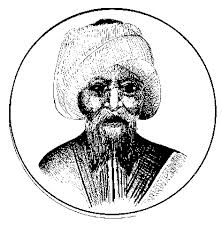
Jabir ibn Hayyan
(last revised
17/03/07)
Alchemy (Gr.
chémeiÄ / chymeiÄ, Ar. kÄ«mÄ«yÄ) has been practised for more than two
millennia and been variously defined in the light of its diverse exoteric and esoteric dimensions. Much
more than a mere prelude to chemistry, it is fundamentally the science and mysticism of
transformation by means of an elixir (Ar. al-iksÄ«r), the "philosopher's stone". IslÄmic alchemy was
widely studied and practiced in Qajar Iran. Both the BÄb and BahÄ'u'llÄh utilized alchemical
terminology in their writings. They revealed Tablets in response to questions about the alchemical
"art". The BÄb entitled one of the chapters of his QayyÅ«m al-asmÄ', the
SÅ«ra of the Elixir (LVII). He
touched upon alchemy in various major works (e.g. KitÄb-i-panj sha'n) and minor epistles (INBMC
67:304-5). Certain statements in the BÄb's writings having to do with precious stones, metals and
opulent edifices, are best understood in the light of notions of alchemically perfected substances and
the ideal eschatological vision. The alchemy of the BÄb is to a considerable
extent rooted in the gnosis of the founders of the Persian Shi`i
movement known as Kashfiyya ("Inner Disclosure") or al-Shaykhiyya (Shaykhism"),
namely, Shaykh Ahmad Zayn al-Din al-AhsÄ'Ä« (d. 1826 CE) and Sayyid KÄẓim
Rashtī (d. 1259/1843) both of whom wrote a good deal about exoteric and
esoteric alchemy (cf. Rashti, Dalīl al-Mutaḥayyirīn, 26).
During his two year withdrawal in Iraqi KurdistÄn (1854-6) BahÄ'-AllÄh was reckoned by some
to be "an adept in alchemy" (GPB:124). In a number of scriptural Tablets dating from the Iraq years, BahÄ'-AllÄh
cryptically divulged some of the secrets of both theoretical and practical alchemy. In his KitÄb-i-Ä«qÄn,
Lawḥ-i SarrÄj and other Tablets (alwÄḥ), he categorically affirms the possibility of transmuting (the base
metal) "copper" into the perfected metal "gold" (see KI:101; Gl. XCVII). He also revealed a Tablet
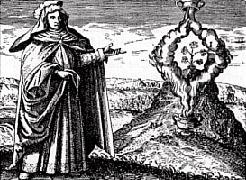
commenting upon a saying of the founding mother of Greek alchemy, Mary the Jewess (`Prophetess'
or `Copt', fl. 3rd cent. CE?): `Take from the "branch" of the "Stone" not from the "root" of the
"Stone"' (Ma'ida, 1:26ff).
Among the scriptural Tablets of BahÄ'-AllÄh known as the "Tablet of the Elixir" (Lawh-i iksÄ«r) is one addressed to
MÄ«rzÄ `AlÄ« Muhammad VarqÄ' (Ma'ida 1:19f). During the late Acre (or `AkkÄ',
"West Galilean") period of
his ministry (1868-1892 CE) BahÄ'-AllÄh specifically forbade the practice of alchemy. He regarded the BahÄ'Ä« revelation
as the true elixir and promoting the BahÄ'Ä« religion as the ultimate "alchemy" (Asrar
al-athar 1:208; AQA
3:356f).Towards the end of his foundational and legalistic al-KitÄb al-Aqdas (=
KitÄb-i Aqdas), BahÄ'-AllÄh mentions "two
signs" of the maturity of the world. In certain writings the first of these
"signs" is interpreted as the realization of that "divine philosophy" which
includes "alchemical" transformation (Aqdas, Para. 189,
p.88, n.194 p.250; AA 1:207f). In various letters Shoghi Effendi indicated that
the future alone would clarify the nature of this process. It might find some
kind of realization through future developments relating to nuclear physics (MÄ'idih 3:15;
Lights of Guidance, No. 1580; cf. RB 3:268).
See further URLs.
Select Bibliography
-
Holmyard, E. Alchemy. New York: Dover Publications Inc., 1990;
-
Hornby, H. (Comp.) Lights of
Guidance 2 (New Delhi: BPT., 1988);
-
IshrÄq KhÄvarÄ«, `KÄ«mÄ«yÄ' in QÄmÅ«s-i
Ä«qÄn 3:1305ff; MÄ'ida-yi asmÄnÄ« [= Ma'ida] Vols. 1, 3;
-
Lambden, Stephen. `Alchemical Gnosis in BÄbÄ«-BahÄ'Ä«
Scripture' (Paper delivered at University of Newcastle upon Tyne, 1984);
-
Lindsay, J. The Origins
of Alchemy in Graeco-Roman Egypt. London: Frederick Muller, 1970;
-
Lory, P. Alchimie et
Mystique en Terre d'Islam. Paris: Verdier, 1989;
-
MÄzandarÄnÄ«, AsrÄru'l-Ä€thÄr Vols. 1:172-3 (IksÄ«r);
5:52 (kÄ«mÄ«yÄ); Amr va khalq 3:350ff.
-
Rashti,
Sayyid KÄẓim, DalÄ«l al-mutaḥayyirÄ«n, Kirman: Sa`Ädat Press, n. d.
[c.1980?].
-
Taherzadeh, A. The Revelation of BahÄ'u'llÄh [= RB] Vol. 3
(Oxford:George Ronald, 1977).
|
