|
|
|
AN ALCHEMICAL EPISTLE OF MĪRZĀ ḤUSAYN `ALĪ NŪRĪ, BAHĀ'-ALLĀH (1817-1892) EXPOSITORY OF AN UTTERANCE ASCRIBED TO MARY THE JEWESS (fl. 1st. Cent. BCE/CE).
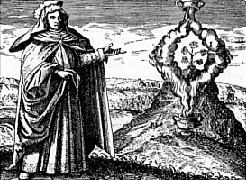
Mary [Maria, Miriam] the Jewess or Prophetess , (fl. 3rd. Cent. CE?) In the Background a diagram of the Conjunctio or the Union of the "Upper" and the "Lower". THIS PROVISIONAL TRANSLATION IS NOW BEING REVISED AND COMPLETED, 2006 Last revised 25/12/05 Stephen N. Lambden
http://www.levity.com/alchemy/maryprof.html
Chapter Five
MARIA THE JEWESS
Despite the frequent references Zosimus makes to Maria, his writings contain practically no clue as to when and where she lived. In his tract on "The Divine Water," however, Zosimus says: "The operation of burning [is] one which all the ancients extolled. Maria, the first, says, 'The copper burnt with sulphur."' [fn.3 = ibid., 180) Elsewhere Zosimus refers to a treatise, On Furnaces and Apparatuses (Peri kaminon kai organon), which seems to have been written by Maria, as a writing of "the ancients." He does this while refusing to comply with the request of his sister Theosebeia, who asked him for information on the subject: he concedes that he is unable to treat it more authoritatively than was done in that ancient treatise. From these references to Maria as the first of the ancient authors one can conclude that she must have lived at least two generations before Zosimus himself. We can thus tentatively assign her to the early third century C.E. at the latest."
ADD FURTHER DETAILS AND SOURCES ETC.. THE ALCHEMICAL EPISTLE OF BAHĀ'-ALLĀH EXPOSITORY OF AN UTTERANCE OF MARY THE JEWESS Translated Stephen Lambden from the text in Ishrāq Khavarī (ed.) Mā'idih-yi āsmānī vol.4:26-45 and corrected in the light of INBMC vol. 66:187-205. (Trans. being revised and completed 2006) [I]
لو لاالقمرلم تكن الشمس ولو لا الفضة لايكن الذهب (al-dhahab)."
[6] By the "silver" We intended the "white Earth" (al-arḍ al-bayḍā'). And it is [thus also] the "white gum" (al-samghat al-al-bayḍā'). [7] We caused the "Gold" to emerge from it and We named it the "red gum" (al-samghat al-ḥamrā'). [8] It [gold] has innumerable names which none none has comprehended save such as are in possession of the knowledge of the [Archetypal] Book (`ilm al-kitāb). [9] And with thy Lord is the knowledge of all things. [10] In His grasp are the keys (mafātiḥ) of the Treasuries of [existing things]. [11] He is Bountiful unto whomsoever He wills and holds back from whomsoever He wills. He, verily, is the Mighty, the Munificent.
[III] [1] And as regards that which she hath stated:
خذ من فرع الحجرلا من اصله ولا من الحجر
[2] Know thou that the [fundamental] basis of the attaining of this noble [alchemical] endeavor [art] is the true knowledge [gnosis] (ma`rifat ) of the illustrious [philosophers'] `Stone' (ḥajar-i mukarram). [3] The taking of the "branch" (far`) of the [philosopher's] "Stone" (ḥajar) is dependent on the real knowledge of the root of the Stone' (aṣl-i ḥajar). [4] Every soul who truly knows the root [of the philosopher's Stone] on the basis of the aforementioned similitudes (amthāl) relating to the [alchemical] work [task] (al-`amal), will attain wealth and self-sufficiency because such a person will be able to perform mighty deeds.
[IV] [1] All the Sages (hukamā') have concealed the root [foundation] of the Stone (aṣl-i hajar) with the utmost secrecy. [2] That which they did set forth of the [alchemical] operations, whether relating to the knowledge of its initial, final or middle stages, they never expounded in a systematic manner. [3] That which they [the Sages] expounded about the external (barrāniyyih) [alchemical] operations was with a view to diverting attention from the basis [`root'] of the internal (javvāniyyih) [alchemical] work. [4] Inasmuch as they found similitudes between the internal (javvāniyyih) [alchemical] operations and those external (barrāniyyih) they expounded them. [5] Wherefore is the [alchemical] exposition of matters external (barrāniyyih) an expression of the ciphers, signs, allusions, metaphors and similitudes of the [alchemical initiates] sages (hukamā').
[5] They, for example, made mention of "gold" (dhahab ). [6] Gold [normally] signifies the kind of gold which exists in a particular [earthly] mine (ma`dan-i makhṣūṣ). [7] But since there is analogy and likeness in terms of color and nature between internal gold (dhahab-i javvāniyya) and external gold (dhahab-i barrāniyya) they simply spoke about "gold". [8] Inasmuch as the people never discovered the real intention [of the sages] they wasted years of their lives occupied with their own idle fancies. [9] In regret they lived and in regret they went about for they never did attain the [alchemical] goal. [10] Their [ the sages] "gold" both is gold and it is not gold. [11] Their moon is the moon and it is not the moon. Thus they [ the Sages] said: `Our gold is not ordinary gold and it is likewise with silver.' [12] In spite of this most of the servants [of God] wasted their lives in darkness about the [true sense of the] external (barrāniyya) [alchemical] operations and failed to attain the authentic daybreak. [V] [1] As for that which they designated internal [gold] (javvāniyyih). [2] This should be viewed in terms of the four elements being hidden in a single reality (sha'y wāḥid) and which they have interpreted as being the [philosophers'] "Stone" (hajar). [3] After differentiation (tafṣīl) on the part of these possessed of insight this same interior [gold] (javvāniyyih) becomes exterior [gold] (barrāniyyih). [4] While the four elements (ṭaba'ī`-yi arba`ih) are concealed in the interior of their own mine [metal] (ma`dan') and are inseparable the term internal [gold] (javvāniyyih) is conferred upon it [the gold? "Stone"]. [5] Then, after outward combination and differentiation the name external [gold] (barrāniyya) is conferred upon it [the gold? "Stone"].[6] On this level external [gold] (barrāniyyih) is the essence (`ayn) of internal [gold] (javvāniyyih) and internal [gold] (javvāniyyih) the spirit (nafs) of external [gold] (barrāniyyih). [7] But some among the sages [alchemical initiates] (ḥukamā'), with respect to the four elements and the four elevated and ancient natures which are concealed and treasured up in the essence of the [philosophers'] "Stone" (nafs-i ḥajar), observed and made mention of realities closely related and connected on a surface level and thus named it external [gold] (barrāniyyih). [8] In such summary fashion was that "gold" [philosophers Stone] made mention of [by the alchemical initiates, the sages]. [VI] [1] The intention of pre-existence (qidam) is pre-existence in time (qidam-i zamānī) not [that pre-existence which is] essential (dhatī) since priority (masbīq) in this case has a cause (`illat). [3] Exalted be He above that which belongs to the sphere of origination (al-ḥudūth). [4] We bear witness that the Logos-Self of the Pre-Existent [Deity](nafs al-qidam), which has been understood by such as are nigh unto God and by the sincere ones who have been called into being on His [God's] part. [5] He [God Himself] has ever been sanctified above the notion of pre-existence (al-qidam) and origination (al ḥudūth). [6] Supremely Holy is He [God] above being described or elucidated. [7] That [reality] which He [God] hath named His "Logos-Self" (nafsahu) relates to the [Divine] Names and Attributes (al-asmā' wa'l-ṣifāt) [which are originated]. [8] This is an expression of His [God's] Grace unto phenomenal existence (al-akwān). [9] Exalted be the All Merciful [God in His essence] far above that which He hath ordained for phenomenal existence (al akwān). [10] He, verily, is the Mighty, the Munificent.[VII] [1] Then know O questioner, that the basis of the [alchemical] task is the true understanding of the [philosophers'] Stone (ḥajar) and the differentiation of that which is hidden within it; its purification (tathīr) and unification (tazwīj). [2] The spirit of the Stone (nafs-i ḥajar) ought, through the instrumentality of its own self, to effect the purification (tathīr) and differentiation (tafṣīl) of the Stone (ḥajar). [3] For, if there be external interference the [desired alchemical] blending (mizāj) will prove difficult. [VIII] [1] So take hold of the [philosophers'] Stone and, through the Azrael of Torment (`izrā'īl-i `azāb [the Angel of Death], cause the "soul" (al-rūh) and "spirit" (al-nafs) to emerge from it [the "Stone"]. [2] Then strive to purify it ["the Stone"] such that it is cleansed and purified of those impurities that inhibit the alchemical reconstitution (tadbīr-i `amaliyyIih; within the "Stone"). [3] And then return again that which hath been extracted [from the "Stone"] to the body (jasad; or substance [of the "Stone"]) so that, through the confirmations of the Israfil of the Spirit (israfil-i rūḥ), that dead body (jasad-i murdih) is brought to life. [4] [Then] Thou shalt observe a wondrous creation, "So blessed be God, the best of Creators" (Q.X:Xx) for the "body" (jasad) cannot receive a contrary "spirit" (rūḥ-i ghayr) nor likewise, the "spirit" (rūh) receive a contrary "body" (jasad). [5] This is the Truth and no doubt is there about it. [6] Although this "soul" (rūḥ) and "spirit" (nafs ) appear to be two realities after the [alchemical] differentiation they are really united in substance (ḥaqīqat) and essence (dhāt) and are but a single reality. [IX]
To be corrected and continued....
|