There follows
the first part of my (completed) provisional translation
of the Qayyūm al-asmā’ (= QA) of the Bab (mid.
1844/1260) with brief introduction and selected notes.
In this instance it is my completion of the authorized
translation of the first surah, the Sūrat al-mulk (Surah
of the Dominion) of Habib Taherzadeh published in
Selections From the Writings of the Bab (= SWB citations
are in quote marks with page numbers indicated). The
Arabic text is cited according to that utilized in this
official translation with a few variants noted. I began
translating the QA in the early 1980s and hope in due
course to post a complete translation of all one hundred
and eleven surahs. The versification of the surahs of
the QA is sometimes uncertain though the Bāb himself
stated that there should be forty-two verses in each (of
the 111) surahs as accords with the abjad numerical
value of lī meaning "before me" in Q. 12:4b (Ar.
لي
= l +
ī = 30+10= 40) and another two representative of "the
sun and the moon" (40+2 = 42). This figure is explicitly
confirmed in the Bāb's early Khuṭba al-dhikriyya ("The
Sermon of the Remembrance") where it is stated in the
context of an imamologically numbered categorization of
the early works of the Bāb dating from between 1260-1262
(AH):
"The
Fourth [revelational categorization] is the Ḥusaynid
Book (kitāb al-Ḥusayniyya) which is the Commentary
upon the Surah of Joseph (Sharḥ Sūrat Yūsuf = Tafsīr
Sūrat Yūsuf = Qayyūm al-asmā') -- upon him be peace
-- which is divided up into one hundred and eleven
firmly established [clearly delineated] (muḥkamat)
surahs. Every one of them is made up of forty two
verses. These constitute a sufficient [messianic]
testimony unto whomsoever exists upon the earth or
lieth beneath the Divine Throne (al-`arsh)..."
(cited Afnan 2000: 472; cf. 445).
I have counted
everything -- (surah title +) basmalah + Q. citation +
isolated letters -- up till the isolated letters as 2
verses (though this is bracketed) and 40 verses until
the end of any given surah. Though the versification of
the surahs of the QA is often uncertain, the rhyming
prose accusative endings are the primary indication.
The same forty-two
mode of surah versification of the QA., is evident in
certain mss. of this work; most notably the early 1261
mss. of Muhammad Mahdī ibn Karbalā'ī where QA1 and 2
(and other surah headings) have the following words
after the surah title (e.g. Surat al-mulk) and in
between the basmala : wa hiya ithnā'[tāni] wa arba`ūn
"and it [the Surah] has forty two verses". In the
following translations I retain this sometimes uncertain
versification for the sake of reference and commentary.
Though he Bāb himself
stated that there should be forty-two verses in each
sūrah of the QA as accords with the abjad numerical
value of the Arabic lī (meaning "before me" in Q.
12:4b Ar.
لي
= l + ī = 30+10= 40 and the additional 2 = 42), it is
not always clear how this figure can be arrived at. In
QA1 the 42 verses seem clear enough though the 42
sometimes seems "symbolic" rather than a clear setting
down of 42 bayts (verses) of rhymed prose (saj`) . Forty
twp verses seems though to hold good for certain
suras such, for example, as QA5. Elsewhere the
"forty-two" configuration cannot easily be configured.
It should also be noted that some verses of the QA are
fairly short while others occasionally extend to make
up a very long pericopae ("paragraphs"). This is also
the case in the Qu'rān itself with which the QA has a
great deal in common; especially respecting its form,
style vocabulary and Arabic in rhyming prose etc.
In neo-qur'ānic
fashion QA1 opens with the standard Islamic basmalah (=
Bismillah al-raḥman al-raḥim, "In the Name of God, the
Merciful, the Compassionate") though without any
prefixed isolated letter(s) such as appear before 28
sūrahs of the 114 Sūrahs of the Q and most of the other
111 Sūrahs of the QA (except, QA 1, 52, 64, 67, 74). No
single qur`ānic verse from Sūrah 12 prefixes QA1 as is
the case before all other sūrahs of the QA which usually
comment upon it fairly briefly in "rewritten" or
"re-revealed" (waḥy) fashion.
As QA1 has no
isolated letters it can be considered a kind of
prolegomenon to the QA proper (cf. the Sūrat al-Fāṭiha,
Q. 1 which is similarly without prefixed isolated
letters). Every subsequent Sūrah (QA 2-111) does
comment in verse by verse fashion upon the whole of the
Sūrah of Joseph (= Q. 12:1-111). The Sūrat al-mulk (=
QA1) is pictured in many Bahā'ī sources dependent on
Zarandī's history (as redacted by Shoghi Effendi in the
1932 and later editions of the The Dawn-Breakers) to
have been revealed by the Bāb on the evening of his
encounter with the young Shaykhī seeker Mullā Ḥusayn
Bushrū'ī (d.1265/1849) in his house in Shiraz on the
evening of 5th Jumādi al-Ūlā [Awwal] 1260/ May 22nd 1844
(Dawn-Breakers, 61ff). The whole of the QA may have been
completed within "forty days" though this may be a
symbolic figure such that its period of completion was
perhaps considerably longer.
Within the English
translation below a few points of transliteration of the
original Arabic have been added along with occasional
clarification including select qur'ānic allusions in
brackets. Some further introductory details to the Sūrat
al-mulk (Surah of the Dominion) can be found in my
unpublished
`The opening Sūrat al-mulk
(Surah of the Dominion) of the Qayyūm al-asmā’ ("The
Deity Self-Subsisting through the Divine Names") of
Sayyid `Alī Muhammad, the Bāb (1819-1850)'.
The first chapter
or surah of the Qayyum al-asma' was entitled Surat al-mulk',
the 'Surah of the Dominion', by the Bāb himself. The
reason for this title relates to the fact that mulk,
meaning `dominion' `kingdom' or `sovereignty', etc. is a
central theme of this first Surah. The centrally
important Arabic word mulk (cf. malik = king) occurs
some 8-9 times (see QA1:20ff) times in key sentences
or verses within QA1. It enshrines meanings indicative
of the global rulership of the earth, which the Bāb
proclaimed should erelong return to the custody of God
Himself through the the messianic Twelfth Imam, the
Dhikr, or their servant the Bāb.
A common
qur'ānic and Islamic expression, al-mulk li-llāhī, "the
Kingdom belongeth to God", indicates that the kingdoms
of this world, are in reality the Kingdom of God (to use
a biblical expression). It indicates a direct or
indirect theocratic rulership of this world to be
established in its fullness in eschatological times. For
the Bāb the mulk Allāh or rule of God will be
established by kings subservient to the coming Qā'im or
12th Imam also known as the Dhikr (Remembrance). If
faithful these kings would be the recipients of divine
favour in the new age. If they take personal part in a
global jihād ("holy war") with the messianic saviour
12th Imam, they would be well compensated (QA 1: ADD).
This predicted global jihad under the Qā'im, of course,
never took place. After QA 1 there appears to be few
instances in the writings of the Bab in which he
specifically calls for a global jihad during the
remaining five or so years of his lifetime.
This
seems to be
presupposed in his early ( 1845 ) epistle to the Shaykhi
leader Ḥajji Mirza Muhammad Kārim Khān Kirmānī
(d.1871) judging by the text cited in the latter's
Risāla al-Shihāb al-thāqib fī rajm al-nawāṣib ("The
Piercing Thunderbolt for the Stoning of the Enemies")
which calls the Kirmani Shaykhi leader to
اخرج لعهد
بقية الله امام عدل مبين
"Come forth [ for service - jihad?] as accords with the covenant of the
[messianic] Remnant of God (baqiyyat-Allah) [ the Hidden
twelfth] a just and manifest Imam". This as
one of the muhājiran (helpers) traveling unto the
country of the Remembrance (al-dhikr) [ Shiraz?] [seated] upon
a powerful steed (fars al-quwwa) with weapons of
requisite perfection (bi'l-ālāt al-makmalat)This
evidently that he might
assist the Hidden Imam and his servant the Bab in their militaristic quest for
eschatological victory.
See further,
http://www.hurqalya.pwp.blueyonder.co.uk/SHAYKHISM/Kirmani1-bab.htm
As time progressed the
call for concrete jihad by the Bab appears to have
become less and less especially after the Bab became
privy to a change in the divine plan through al-bada
(refer ADD ). The earliest jihād
call of the Bāb to the earthly rulers (perhaps
1844-6-8?) was never realized. Even the later Babi
upheavals (1848-1852) appear never to have been
precipitated by a specific call of the Bab for jihād.
While jihad activity always remained a distinct,
theological possibility for the Bāb, it never came to
have to have a concrete, militaristic realization. As
Bahā'-Allāh argued in his Kitab-i īqān ("Book of
Certitude", 1862), the sovereignty of the Bāb as the
Qā'im was destined to be more like that of Jesus Christ
than Muhammad. It was a "spiritual", unworldly
sovereignty not a concrete theocracy established by
warmongering followers. The anticipated Shī`ī jihād
("holy war") predicted in numerous traditions of the
Prophet Muhammad and the Imams was never realized in
worldly terms. Neither "kings" nor the "sons of kings"
rose up for any jihād episode called for in QA1.
Rather, it was religiously inclined, youthful scholars
of the Shaykhī school who early came to faith in the Bāb,
not so much well-armed fighters or fanatics of a
militaristic disposition. The mulk Allāh, the rule,
sovereignty or kingdom of God anticipated in the QA.,
was established in such human hearts as were ready for
martyrdom in the service of the Bāb, not fighters
lusting after booty or such persons as are desirous of
worldly conquest and success.
Unlike the Bab,
Bahā'-Allāh taught that the triumph of his religion
would be independent of any holy war and will not be
realized with the assistance of worldly kings or
monarchs:
We have pledged Ourselves
to secure Thy triumph upon earth and to exalt Our Cause
above all men, though no king be found who would turn
his face towards Thee (trans. GWB: 248‑249).
In another Tablet
Bahā'-Allāh stresses the importance of fellowship with
the followers of all religions and states that "the law
of holy war hath been blotted out from the Book" (Bahā'-Allāh:
Aqdas: Notes, Page: 241). Many other passages in the
writings of Bahā'-Allāh in one way or another bear upon
the undesirability of jihad, the folly of warfare and
the necessity of peace, collective security, and the
means for the globalization of his religion. Only a few
examples can be cited here. In an Arabic Tablet to a
certain (unidentified) `Ali partially published the
compilation Ma’idih-yi asmani, Bahā'-Allāh states:
We indeed lifted up the
hukm al-sayf wa’l-sinan (decree of the sword and
spears) and We decreed that victory (al-nasr) be through
exposition [of the sacred Word] (al-bayan) and that
which comes out from the tongue. He indeed is the
Sublime (Ma’idih 4:18)
Among the numerous similar
passages on these lines found in the writings of
Baha’u’llah the following is an interesting example
found in a Tablet to a certain Mashhadi Haydar
entitled Sahifat-Allah (The Scroll of God) :
O Husayn before
`Ali... Say: through Him the ocean of exposition hath
surged and the breeze of the All-Merciful hath wafted...
Say: He, through his Pen hath bypassed the swords of the
nations and interdicted --? - and qittal (killing) and
the decree of jihad. He verily is the most Merciful of
such as show mercy. This is the hidden matter unto which
the books testify. (INBMC 23: [187-195]:189)..
In the late
Tablet of Bishārat, (c. 1891) the very first
Glad-Tiding, like the first “Word” uttered at the time
of the Ridwan declaration, is as follows:
“O people of the
earth! The first Glad‑Tidings which the Mother
Book hath, in this Most Great Revelation,
imparted unto all the peoples of the world is
that the law of holy war (jihad) hath been
blotted out from the Book…(TB:21).
Distinctly
echoing the Isaiah 2:4, Bahā'-Allāh also desires,
according to the aforementioned scriptural Glad-Tidings
(Bisharat), that "weapons of war [Isaiah = “swords”]
throughout the world may be converted into instruments
of reconstruction [Isaiah = “ploughshares”] and that
strife and conflict may be so removed from the midst of
men and shall learn war no more]" (cf. Isaiah 2:4 and
Micah 4:1-2).
Thus for the one-time
leading Bābī, Bahā'-Allāh and his followers the Bahā'īs,
the Bāb's promise of the theocratic sovereignty of God
is being realized through the propagation of a religion
which commenced with an 1863 declaration (by Bahā'-Allāh)
of the abrogation of the law of concrete jihād. This in
favour of the propagation of religion through the
peaceful means of a religious exposition (Ar. bayān)
characterized by ḥikma ("wisdom") such as would
maintain peace and the unity in diversity of humankind.
A well-known Persian Baha'i prayer of Bahā'-Allāh reads:
"God grant
that the light of unity may envelop the whole earth
and that the seal al-mulk li-llāhī (`the kingdom is
God's) may be stamped on the brow of all its
peoples'.
The call for
mulk Allāh or al-mulk li-llāhī , the sovereignty of
God voiced by the youthful Bāb in QA1 in 1844, was,
twenty years later (in
late
April-early May 1863) transformed by Bahā'-Allāh
into a call for peace realized without concrete
"holy war".
The phrase
الامر البديع
al‑amr al‑badī`
in Qayyūm
al-asma' I:9
انّ
هذا لهو السّرّ فی السّموات و الارض و علی
الامر البديع
باذن*
اللّه العلیّ
قد كان بالحق فی امّ الكتاب مكتوباً
"This is the Mystery (al-sirr)
[which hath been hidden] from all that are in heaven and
on earth, and in this
الامر البديع
al-amr al-badī`
,
"wondrous
Revelation" (or) "revolutionary/new Cause"
it hath, in very truth, been set forth
in the Mother Book by the hand of God, the Exalted."
(SWB:41)
The subtle apocalyptic language of the Qayyum al-asma'
at I:9 seems to presuppose the exposure of a once hidden
yet new or revolutionary al-amr, a religious
"Cause" championed by the hidden Imam and his
representative the Bab. The official Baha'i translation
here (in SWB: 41 ) slightly obscures this matter by
non-literally translating al-amr al-badi`
(literally, “the new/ innovative/ wondrous command
/Order /Cause" as “this wondrous Revelation”. A number
of Shi`i messianic traditions predict the eschatological
emergence of a new amr, a new religious Cause.
Islamic traditions have it that the
messianic Qa’im, the sahib al-amr (bearer of a
Cause /Command) will establish a new religious amr
(religious “Cause”) which will be propagated
throughout the globe. One hadith originating with
Ja`far al-Ṣādiq as cited by Shaykh al-Mufid is fairly
explicit in this respect:
ADD ARABIC TEXT
When the Qa’im… rises, he will
come with a new amr (religious “Cause”),
just as the Messenger of God [Muhammad] (rasul
Allah) …at the genesis of Islam summoned
unto a new amr (religious “Cause”)” (Irshad,
364).
The word amr in the
phrase amr jadid within this tradition could
have a very wide range of possible senses including
being indicative of a new “Command”, “Order” , “Cause”
and even “religion”. Shi`i traditions about a new
amr are more explicitly quoted by the Bāb in his
Tafsīr Sūrat al-Kawthar and also by Baha'-Allah in
his K. īqān and other writings. This amr
is usually understood in Bābī-Bahā’ī writ to mean a
new religion, revelation, religious order or “Cause”.
For Bahā’īs the (Per.) Amr-i ilāhī indicates the
Cause or Religion of God . The Bahā’ī religion today is
often referred to as the amr-i ilāhi.
The kind of eschatological expectations
presupposed in QA1 are expressed in messianic traditions
such as the following: Abu `Abd-Allah [Ja`far al-Ṣādiq]..
Said, `...His [the Qa’im’s] Shi`a [party] will come to
him from the ends of the earth (aṭrāf al-arḍ), rolling
up in great numbers to pledge allegiance to him. Then
God will fill the earth with justice (fayamla’ Allah
bihi al-arḍ `adl an) just as it was filled with
injustice (ẓulm an)... (cited al-Mufid, K. Al-Irshád,
379 trans. Howard, 548).
The messianic Qa'im furthermore, has the role of
establishing justice and peace within a new dawla or
"state". In the K al-Irshād of Shaykh al-Mufid it is
recorded that `Alī b. `Uqba reported on the authority of
his father, an Imami tradition which includes specific
mention of the establishment of justice, safety and
peace at the time of the universal reign of the
messianic Qa’im. The conversion or destruction of all
non-Muslims will have been achieved by a universal,
just, and peaceful Shi`i dawla (“state”), the final
global state:
“When the Qā’im.. rises he will rule the earth
with justice. In his time, injustice will be
removed and the roads will be safe. The earth
will produce its benefits and every due will be
restored to its proper person. No people of any
other religion will remain without being shown
Islam and confessing faith in it.. He will judge
between the people with the judgment (ḥukm) of
David and the law (ḥukm) of Muhammad... At that
time the earth will reveal its treasures (kunuz)
and show its blessings. At that time men will
not find any place to give alms nor be generous
because wealth will encompass all the
believers.... Our state (dawla) is the last of
the states (akhir al-duwal). No House (ahl al-bayt)
which has a state (dawla) will remain except
that they ruled before us, so that they will not
be able to say when they see our actions, if we
ruled we would act in the same way as these. It
is as the word of God, the Exalted, The final
result is for those who are pious (Q. VII 128)”
(cited al-Mufíd, al-Irshád, 384-5 trans. Howard,
552-3; translit. added).
Summing up the implications of this and
related Imami messianic traditions Abd al-`Aziz Sachedia
in his Islamic Messianism, the Idea of the Mahdi in
Twelver Shi`ism (Albany: SUNY, 1981) writes as follows,
the zuhur [of the Mahdi] proper will take place in
Mecca, the birthplace of Islam. Al-Mahdi, like the
Prophet, will come with a new order and will call the
people to follow that order, as did the Prophet at the
beginning of Islam [Mufid, al-Irshād, 705]. That new
order will restore the purity of Islam as taught by the
prophet and the Imams. The order will carry within
itself the religio-social-politcal aspects of the
pristine Islam. Thus the commencement of the appearence
of the Mahdi in Mecca, more specifically in the Ka`ba,
between the Rukn and the Maqam, the two holy spots in
the precinct, not only increaces the significance of the
twelfth Imams mission, but also preserves the symbolic
unity of the umma by launching it in Mecca. This is the
import of the phrase mahdi al-umma -- the Mahdi of the
people -- the title on which the Imamite scholars placed
great emphasis during the early years of the Complete
Occultation” (Sachedia, Messianism, 160).
The emergent religion of the Bab, the al-din
al-khalis (the purified religion") as glimpsed in the
Surat al-mulk of the Qayyum al-asma' is to a
considerable degree shaped by numerous, sometimes
detailed Imami messianic traditions of the kind cited
above. They provide the context within which many of his
earliest statements are best understood. His first
followers were pious Shi`i Muslims many with distinct
messianic and eschatological expectations.
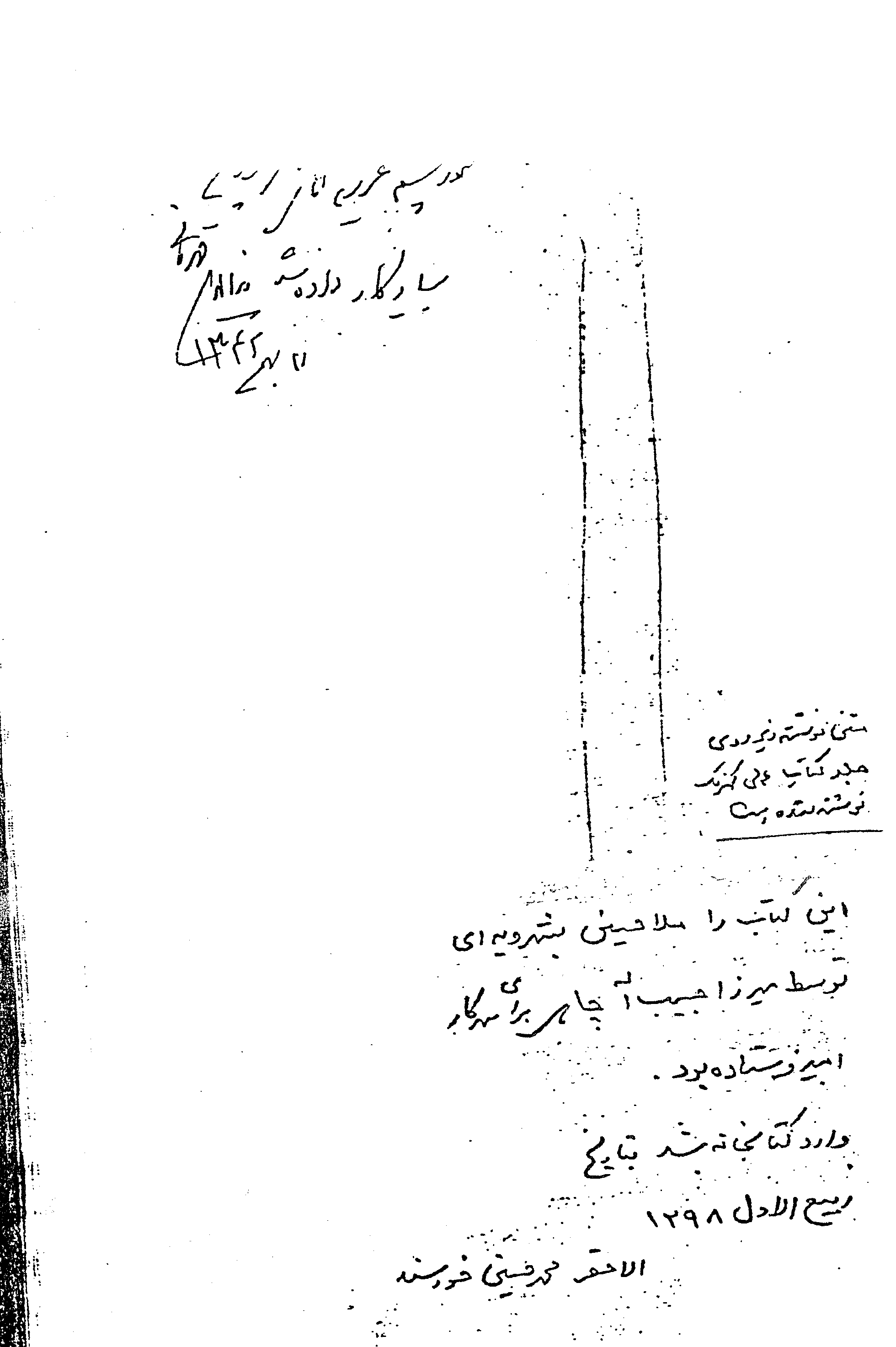
SCANS FROM A COPY OF AN EARLY
1261/1845 MSS. OF QA. 1



COVER PAGE02 + QA001A-P3 +
QA001B-P4
QAYYŪM AL-ASMĀ'
I
The
Surah of the Dominion
سورة
الملك
Sūrat al-mulk
[1]
بسم
الله الرحمن الرحيم
الحمد لله الذی الّذی نزّل الكتاب علی عبده بالحقّ
ليكون للعالمين سراجاً وهّاجاً
"ALL praise be to God Who
hath, through the power of Truth, sent down this Book unto His
servant [the Bāb],
that it may serve as a
shining light for all mankind."
(SWB:41)
[3]
انّ
هذا صراط علیّ عند ربّك بالحقّ
قد
كان فی امّ الكتاب علی الحق القيّم
مستقيماً
This,
in truth, in the estimation of God, is the Exalted Path (sirāṭ
`aliyy) [`Alī ]
It
verily, stretches upright according to the truth established in
the Mother Book
(umm al-kitāb)
[4]
و انّه فی امّ الكتاب لدينا لعلیّ
و علی الحق الاكبرقد
كان عند الرّحمن حكيماً
And He
is, in the Mother Book which is before Us, assuredly One
Exalted, One according to the Most Great Truth
(al-ḥaqq
al-akbar),
reckoned wise (ḥakīm an) on the part of the
All-Merciful.
[5]
و انّه الحق من عند اللّه
*علی
الدّين الخالص
قد
كان فی امّ الكتاب
*
مسطوراً
He is
the True One from God (al-ḥaqq min `and Allāh) according to the
pure religion (al-dīn al-khāliṣ)
inscribed in the Mother Book in the vicinity of the Mount
[Sinai]
(al-ṭūr).
[6]
انّ
هذا لهو الحقّ صراط
اللّه فی السّموات و الارض
فمن شاء
اتّخذه الی اللّه بالحقّ سبيلاً
"Verily, this is none other than the sovereign Truth; it is the
Path which God (ṣirat Allāh) hath laid out for all
that are in heaven and on earth.
Let him
then who will, take for himself the right path unto his Lord.
(SWB:41)
[7]
انّ هذا لهو الدّين القيّم و كفی باللّه و من
عنده علم الكتاب شهيداً
"Verily
this is the true Faith of God, [Upright Religion] (al-dīn al-qayyim).
And
sufficient witness are God and such as are endowed with the
knowledge of the Book (`ilm al-kitāb)."
(SWB:41)
[8]
انّ هذا لهو الحقّ بالحقّ علی الكلمة الاكبر من اللّه القديم
قد كان من حول النّار مبعوثاً
"This
is indeed the eternal Truth which God,
the
Ancient of Days (al-qadīm), hath revealed unto His
Omnipotent Word [Greatest Word] (al-kalimat al-akbar) --
He Who
hath been raised up from the midst of the Burning Bush
[Sinaitic
Fire] (al-nār )."
(SWB:41)
[9]
انّ
هذا لهو السّرّ فی السّموات و الارض و علی الامر البديع
باذن*
اللّه العلیّ
قد كان
بالحق فی امّ الكتاب مكتوباً
"This
is the Mystery (al-sirr) which hath been hidden from all
that are in heaven and on earth, and in this wondrous Revelation
("Cause",
al-amr al-badī`)
it hath, in very truth,
been set forth in the Mother Book by the hand of God, the
Exalted."
(SWB:41).
[10]
اللّه قد قدّر ان يخرج ذلك الكتاب فی تفسير احسن القصص
من عند محمّد بن الحسن بن علی بن محمّد بن علی بن موسی
بن جعفر بن محمّد بن علی بن الحسين بن علی بن ابيطالب
علی عبده ليكون حجّة اللّه من عند الذّكر علی العالمين بليغاً
God, verily,
hath decreed that this Book be divulged
in
interpretation
(tafsīr)
of
the "Best of Narratives" (aḥṣan al-qaṣaṣ,
Q.12:3) [= the Joseph story in the Qur'an] on the
part of Muhammad [the hidden 12th Imam] son of Ḥasan
[al-`Askarī, 11th Imam] (d. c. 260/874] son of `Alī
[al-Hadi, 10th Imam](d. c. 254/868) son of Muhammad
[al-Taqī, 9th Imam[ (d. c. 220/835)
son of
`Alī [al-Riḍā',
8th Imam, d. c. 203/818]
son of Mūsā
[al-Kāẓim, 7th Imam] (d. c. 183/799) son of Ja`far
[al-Sādiq, 6th Imam], (d. c. 148/765)son of Muhammad
[al-Bāqir,
5th Imam] ( d. c. 120/738?)
son of
`Alī
[Zayn al-`Ābidīn,
4th Imam] (d. c. 95/713)
son of Ḥusayn
[3rd Imam] (d. c. 61/680)
son of
`Alī
ibn
Abī
Ṭālib [1st
Imam] (d. c. 40/661) unto His servant [= the Bāb]
(d. 1266/1850)
to the end
that it might be an eloquent Proof of God
(ḥujjat-Allāh)
from the Remembrance
(al-dhikr)
unto all the worlds.
[11]
اشهد اللّه كشهادته لنفسه انّه الحقّ
لا اله
الا
هو و الملائكة واولوالعلم
قوّام
حول
الذّكر
بالقسط
لا
اله
الا
هو
وهو اللّه كان بكلّ شیء
عليماً
God beareth
witness as if through the testimony of His own
Logos-Self for He, verily, is the True One. No God
is there except Him. So too the angels
(al-malā'ika)
and the
possessors of knowledge (ulu al-`ilm)
standing, as accords with justice, upright about the
Remembrance (al-dhikr). No God is there
except Him and God knoweth all things.
[12]
انّ
الّدين الخالص هذا الذّكر سالم
فمن اراد الاسلام فليسلّم امره لان يكتبه اللّه فی كتاب الابرار
مسلماً
و علی الدّين الخالص قد كان
بالحق
محموداً
The pure
Religion (al-dīn al-khāliṣ) of this Remembrance (al-dhikr)
is faultless
(sālim).
Whomsoever
desireth [to identify with true] Islam let such an
one be submissive unto this Cause (al-amr), for
such shall God accord the status of a Muslim in the
Holy Book
(kitāb
al-abrār)
according to
the pure Religion (al-dīn al-khāliṣ) worthy of
praise (cf. Q. 3:18-19).
[13]
و من يكفر بالاسلام لن يقبل اللّه عنه من اعماله
قد كان فی يوم
القيمة من بعض الشیء علی الحقّ بالحقّ
شيئاً
And
whomsoever disbelieveth in Islam shall not have his deeds
accepted by God
on the Day of
Resurrection;
not
the least thing, as befits the Truth, shall in any way be
accepted.
[14]
و حقّ علی
اللّه ان يحرقه بنار اللّه البديع بحكم الكتاب
من
حكم الباب محتوماً
Fitting
it is that God burn him in
the regenerative
Fire of God (nār Allāh al-badī`)
according to the decree of the Book sealed up, in very Truth,
in accordance with the decree of the Gate
(ḥukm al-bāb)
[15]
اللّه
الّذی لا اله الا هو
و هو اللّه كان بالمؤمنين بصيراً
God is
He Who no God is there except Him. And He is God One
Ever-Aware of the believers
[16]
اللّه الّذی لا اله
الا
هو وهو
اللّه كان بالمؤمنين شهيداً
God is
He Who, no God is there except Him. And He is God, One Witness
unto all the worlds the believers.
[17]
اللّه الّذی لا اله
الا
هوو هو
اللّه كان
بالمؤمنين
عليماً
God is
He Who, no God is there except Him. And He is God, One
All-Knowing about the believers.
[18]
اللّه الّذی لا اله
الا
هو
و هو
اللّه كان
بالمؤمنين*
محيطاً
God is
He Who, no God is there except Him. And He is God, One
All-Encompassing of the believers.
[19]
و انّ اللّه
لن يقبل من احد من بعض العمل
الامن
اتی الباب بالباب ساجداً للّه القديم
من حول الباب محموداً
God
will not accept from anyone any deed
except from one who
arrives at the Gate, through the Gate (al-bāb bi'l-bāb =
Q.12:XX)
prostrate before God, the Ancientand praiseworthy in the
vicinity of the Gate
[20-1]
ا
للّه
قد اذن لك علی الحقّ
فاسجد و اقترب فانّ النّار فی نقطة الماء
للّه الحقّ قد كان
ساجداً
علی
الارض بالحقّ مشهوداً
God
hath, in very truth
given
thee permission
[to accomplish
this] !
So be prostrate and draw nigh for the [Sinaitic]
Fire (al-nār) in the Point [Locus] of [Cosmic] Water (nuqṭat al-mā')
is evidently, in very truth,
prostrate upon the earth before God, the True One.
[22]
يا معشر الملوك و ابناء
الملوك
انصرفوا
عن ملك اللّه جميعكم بالحقّ علی الحقّ جميلاً
"O
concourse of kings and the sons of kings!
(yā ma`shar al-mulūk wa abnā' al-mulūk)
Lay aside, one and all
[in truth, as befits the Truth] your dominion which belongeth
unto God (mulk Allāh)."
(SWB:41)
[23]
يا ملك المسلمين
فانصر بعد الكتاب ذكرنا الاكبر
بالحقّ
فانّ اللّه قدّر لك و للحافين من حولك فی يوم القيمة
علی الصّراط موقف
اً
علی الحقّ مسئولاً
"O king
of Islam! [Muhammad Shah r.1834-1848]
(lit.
"king of the Muslims", malik al-muslimūn)
Aid thou,
with the truth, after having aided the Book, Him
Who is Our Most Great Remembrance
(dhikrinā al-akbar)
for God hath, in very truth, destined for thee,
and for such as circle round thee, on the Day of
Judgment [Resurrection], a responsible position in
His Path."
(SWB:41)
[24]
يا
ايّها الملك تا
للّه الحقّ لو تعادی مع الذّكر
ليحكم اللّه فی يوم القيمة عليك
بين الملوك بالنّار
و لن تجد اليوم من دون اللّه العلیّ الحقّ بالحقّ ظهيراً
"I
swear by God O [Muhammad] Shah!
[lit. O thou
king!] If thou showest enmity unto Him Who is His
Remembrance, (dhikr) God will, on the Day of
Resurrection, condemn thee, before the kings, unto
hell-fire, and thou shalt not, in very truth, find
on that Day any helper except God, the Exalted."
(SWB:41-2)
[25]
يا ايّها الملك
طهّر الارض المقدّسة من اهل الرّد الكتاب
من قبل يوم جاء
الذّكر
فيها بغتة باذن اللّه
العلیّ علی الامر القوّی شديداً
Purge thou,
O [Muhammad] Shah,
the Sacred
Land (al-arḍ al-muqaddas) [= Tehran] ( the `atabāt
in Ottoman Iraq) from such as have repudiated the
Book (ahl al-radd),
ere the day whereon the Remembrance of God (al-dhikr)
cometh, terribly and of a sudden, with His
potent Cause (al-amr al-qawiyy) by the leave
of God, the Most High." (SWB:42)
[26]
و انّ اللّه قد كتب عليك ان تسلّم الذّكر و امره
و تسخر البلاد بالحقّ باذنه
فانّك فی الدّنيا مرحوم علی الملك
و فی الاخرة
من اهل جنّة الرّضوان حول القدس
قد كنت مسكوناً
"God,
verily, hath prescribed to thee
[
Muhammad Shah] to
submit unto Him Who is His Remembrance
(al-dhikr)
, and unto His Cause
(al-amr), and
to subdue, with the truth and by His leave,
the countries, for in this
world thou hast been mercifully invested with
sovereignty, (al-mulk)
and wilt, in the
next, dwell, nigh unto the Seat of Holiness,
with the inmates of the Paradise of His good-pleasure"
(jannat
al-riḍwān, lit. `Garden of Riḍwān).
(SWB:42)
[27]
يا ايّها الملك لايغرّنك الملك فانّ لكلّ نفس ذائقة الموت
قد كان بالحقّ علی الحقّ من حكم اللّه مكتوباً
"Let not thy sovereignty (al-mulk) deceive
thee, O [Muhammad] Shah, for `every soul shall taste of
death,' [Q. 3:182]
and this, in very truth,
hath
been written down as a decree of God."
(SWB:41)
[28]
و ارض بحكم
اللّه الحقّ فانّ الملك فی امّ الكتاب
علی شأن
الذّكر بايدی اللّه قد كان بالحقّ مسطوراً
Be thou content with the commandment of God the True
One, inasmuch as sovereignty (al-mulk)
as
recorded in the Mother Book (umm al-kitāb) by the hand of God
is surely invested in Him Who is the Remembrance (al-dhikr).
[29]
و انصروا اللّه بانفسكم و اسيافكم فی ظلّ هذا الذّكر الاكبر
لهذا
الدّين الخالص بالحقّ علی الحقّ قويّاً
And [O kings!] give aid
towards victory before God through thy very own selves and thy
swords (bi-anfusikum
wa asyāfikum)
in the
shade of the Most Great Remembrance
(al-dhikr al-akbar)
for the sake
of this pure Religion
(al-dīn al-khāliṣ)
which is, in
very truth, mighty.
[30]
يا وزير الملك
خف عن اللّه الّذی لا
اله الّا هو الحقّ العادل و اعزل نفسك عن الملك
فانا
نحن قد نرث الارض و من عليها باذن اللّه الحكيم
و انّه قد كان بالحقّ عليك و علی الملك
شهيداً
"O
Minister of the Shah! [King]
(wazīr al-malik)
[
= Ḥajjī Mīrzā Āqāsī c.1783-1848]
Fear thou
God, besides Whom there is none other God but
Him, the Sovereign Truth, the Just, and lay aside
thy dominion (al-mulk), for We, by the leave of
God, the All-Wise, inherit the earth and all who
are upon it (cf. Q.19:41), and He shall
rightfully be a witness unto thee and unto the Shāh
[King] (al-malik )."
(SWB:42-3)
[31]
و انّا نحن قد ضمّنا باذن اللّه لانفسكم
ان تطيعوا الذّكر بالصّدق الخالص بانّ لكم فی القيامة
فی جنّة العدن ملكاً
علی الحقّ عظيماً
"Were ye to
obey the Remembrance of God
(al-dhikr)
with absolute sincerity,
We guarantee,
by the leave of God,
that on the
Day of Resurrection,
a
vast dominion (al-mulk an `aẓīm
an)
shall be
yours in
His
eternal Paradise
(jannat al-`adn, Garden
of Eden)."
(SWB:43)
[32]
و انّ ملككم هذه
باطلة
و قد جعل اللّه
متاع الدّنيا للمشركين
و انّ عند اللّه موليكم حسن الماب
قد كان بالحقّ علی الحقّ قديماً
"Vain indeed is your
dominion [O Kings!], for God hath set aside earthly
possessions for such as have denied Him; for unto
Him Who is your Lord shall be the most excellent
abode [`the best return'], (ḥasan al-mā'ab), He Who
is, in truth, the Ancient of Days"
(al-qadīm
an).
(SWB:43)
[33]
و انّ لنا فی جنّة الخلد
ملكاً رفيعاً
نعطی من نشاء
من عبادنا
ممّن
كان فيهذا الباب
باللّه و لاياته علی الحقّ نصيراً
With Us is an
elevated dominion
(al-mulk
an rafī` an )
in the Garden
of Eternity
(jannat al-khuld) which
We bestow upon such as We desire among Our
servants such, that is, as are established in this
Gate (al-bāb) by God and in very truth, an upholder
of His verses
[34]
يا معشر الملوك
بلّغوا آياتنا
الی الترك و ارض الهند بالحقّ علی الحقّ سريعاً
"O concourse of kings!
(yā
ma`shar al-mulūk)
Deliver
with truth and in all haste the verses sent down by Us, to the
peoples of Turkey and of India,
(
SWB:43)
[35]
و ما
وراءِ ارضها من مشرق الارض
و غربها بالحقّ علی الحقّ قويّاً
and
beyond them, with power and with truth, to lands in both the
East and the West
."
(
SWB:43)
[36]
يا عباد الرّحمن
انّ اللّه ما خلقكم و ما رزقكم
الا
لامر
قد كان عند اللّه فی امّ الكتاب علی الحقّ بالحقّ عظيماً
O
servants of the All Merciful!
God did
not create you or provide for you except with respect to a Cause
(amr) which, in very truth, is mighty before God in the
Mother Book
(umm
al-kitāb).
[37]
و اتّبعوا ما اوحی اللّه الينا من احكام الباب فی ذلك الكتاب
مسلّماً للّه و لامره علی الحقّ رضيّاً
So
follow ye! that which God hath revealed unto Us of the decrees
of the Gate (al-bāb) in this Book,
submissive before God and, in very truth, content with His
Cause.
[38]
وعلموا ان تنصروا اللّه ينصركم فی يوم القيمة
بالذّكر الاكبر علی الصّراط نصراً كريماً
"And
know that if ye aid God, He will, on the Day of Resurrection,
graciously aid you, upon the Bridge (al-ṣirāt), through
Him Who is His Most Great Remembrance
(al-dhikr al-akbar)."
(SWB:43)
[39]
تاللّه ان احسنتم احسنتم لانفسكم
وان تكفروا باللّه و باياته
لكنّا باللّه عن الخلق و الملك علی
الحقّ غنيّاً
"By
God! If ye do well, to your own behoof will ye do well; and if
ye deny God and His signs [verses],
We, in
very truth, having God, can well dispense with all creatures and
all earthly dominion
(al-mulk)."
(SWB:42)
[40]
يا اهل الارض
من اطاع ذكر اللّه و كتابه
هذا فقد اطاع اللّه و اوليائه بالحقّ
و قد كان فی الاخرة من اهل جنة الرّضوان عند اللّه مكتوباً
"O people of the earth!
Whoso obeyeth the Remembrance of
God
(dhikr-Allāh)
and
His Book hath in truth obeyed God and His chosen
ones and he will, in the life to come, be reckoned
in the presence of God among the inmates of the
Paradise of His good-pleasure." (jannat al-riḍwān,
`Garden of Riḍwān')
(SWB:43)
[41]
و انّا نحن قد سيّرنا الجبال علی الارض و النّجوم علی العرش
حول النّار فی قطب الماء
من لدی الذّكر باللّه الحقّ
و لن يغادر
منكم احداً احداًً
We,
verily, have set the mountains on earth in motion
as well as the stars above the heavenly Throne
in the vicinity
of the Sinaitic Fire (al-nār)
in the Pivot of
the watery Expanse
(quṭb al-mā'),
this
by virtue of the Remembrance (al-dhikr), through
God, the True One. Not
any one among you shall be left out [at the time of
assembling for judgment]
(Q.18:47f)
[42]
و هو القاهر فوق عباده هو
اللّه كان بكلّشیء عليماً
He is
One Wrathful
(al-qāhir)
beyond His servants.
And
God is He Who knoweth all things.
Select text critical Notes FOR QA 1
in progress 2006-7
-
A = QA ms. 1261 = Muhammad
Mahdī ibn Karbalā'ī, dated 1261. One
of the earliest extant mss.
-
B = QA cited Izhaq = early
citations of the QA in Muhammad
Karim Khān Kirmanī (d. 1871, the
Shaykhī anti-Bābī-Baha'ī leader),
Izhāq al-bāṭil ("The Crushing
of Falsehood", 1261/1845).
-
C = QA ms. F.11 = Browne
Coll. Cambridge Univ. F.11 (1891)
-
D = QA ms. 1323 = QA copy
made 1st Muḥarram, 1323/ 8th March
1905.
-
ADD
-
|
|
The Arabic text above will erelong be that of mss. A
above (in progress). Alternative or variant readings
deriving from other mss. are indicated by a red
asterisk (*)
and the exact alternatives spelled out in the footnotes
below the verse being indicated as QA1: verse number.
QA1 :5 .
The readings inserted in red are are from mss. D (mss.
1323)
نّه الحق من عند اللّه
*و
علی
الدّين الخالص
قد كان فی امّ الكتاب
*
حول
الطّور مسطوراً
He is the True
One from God
(al-ḥaqq min `and
Allāh)
according to the
pure religion
(al-dīn al-khāliṣ)
inscribed in the Mother Book
in
the vicinity of the Mount
[Sinai]
(al-ṭūr )...
QA1: 9 . The
readings inserted in red are readings are from mss. D
(1323)
انّ
هذا لهو السّرّ فی السّموات و الارض و علی الامر البديع
باذن* [بايدی]
اللّه العلیّ
قد كان بالحق فی امّ
الكتاب مكتوباً
"This is the
Mystery (al-sirr) which hath been hidden
from all that are in heaven and on earth, and in
this wondrous Revelation
("Cause",
al-amr al-badī`)
it hath, in
very truth, been set forth in the Mother Book with
the permission of God, the Exalted
by the
[two] hands of
God, the
Exalted."
(SWB:41).
QA1:
18 ADD details
اللّه الّذی لا اله
الا
هو
و هو
اللّه كان
بالمؤمنين*
محيطاً
"God is He Who,
no God is there except Him. And He is God, One
All-Encompassing of the believers".