ModEco: Integrated Software for Species Distribution Analysis and Modeling
ModEco is a user-friendly software that enables researchers and students to fully and easily explore the rapidly increasing wealth of species distribution data. ModEco will consist of four major components: data management and visualization, feature analysis, model training and prediction, and accuracy assessment. The proposed tools will incorporate a range of methods for species niche modeling as well as several feature selection methods to improve the prediction accuracy. This combination of features will foster better understanding of the relationship between species distribution and environmental variables. ModEco will be freely available and can run on different operating systems.

Data management and visualization
ModEco uses a project file to organize data layers and model parameters. The project file is stored in Extensible Makeup Language (XML) format, and consits of the following six components:
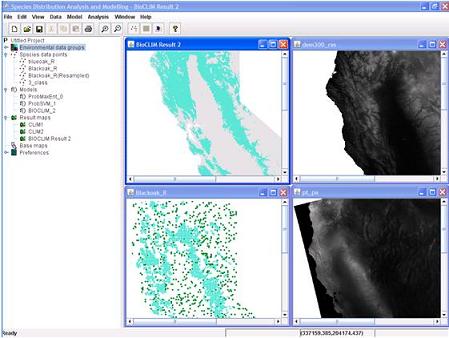
- Environmental data groups. Examples of environmental data are climatic variables and elevation data. One important feature of environmental data groups is that it allows users to import multiple sets of environmental data. This feature can support the environmental data storage for a certain species in different time periods, which could be used to predict future or historic species' distributions using the same niche model trained by the current species distribution and current environmental data.
- Species data points. ModEco provides functions to import presence only and presence / absence data in either text file or ESRI shape file formats. It can also track the species data types to help users select the suitable niche model for their data. Multiple species data sets will be supported by ModEco, and can be batch run in the modeling.
- Models. Once users select a specific model with a set of parameters, the information will be stored in the model component. Users can select the same model for different environmental data groups, which is useful for studying species distribution between different time periods.
- Result maps. Species prediction results can be saved as result maps, which can be exported to either BIP or ASCII GRID files.
- Base maps. Base map includes spatial data that are used to aid model selection and data visualization.
- Preferences. Some global settings of a project are stored in the preference component.
Feature analysis
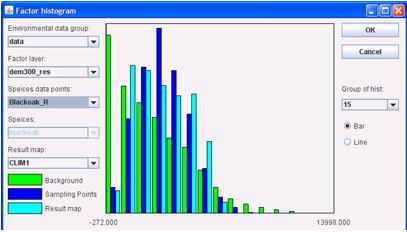 ModEco provides functions that allow users to visualize the relationship between observed species localities and environmental layers. Functions include:
- factor histogram
- scatter plot
- factor selection
Model training and prediction
ModEco implements two types of models (one-class methods and two-class methods). For the one-class methods, ModEco will include two widely used methods (DOMAIN and BioClim) and a newly developed method (one-class support vector machines). For the two-class methods, we will develop generalized linear models, maximum likelihood classifiers, two-class support vector machines, artificial neural network, and rough set.Model evaluation and accuracy assessment
Accuracy assessment methods included cross-validation accuracy, Receiver Operating Characteristics curves (ROC), areas under the ROC curves (AUC), error matrix, and maximum Kappa values.
Currently, ModEco package is under development. Once it becomes available, this page will be updated to provide the software download.

This project is funded by National Science Fundation.