GIST (Gesture Interpretation using Spatio-Temporal analysis) project is an attempt to recognize and interpret sign gestures of American Sign Language from a video sequence based on an integrated method of motion segmentation, shape, size and color. A multi-scale motion segmentation based on Ahuja's New Transform is applied to a video sequence to get motion regions and their correspondence across frames. Regions of interest, such as fingertip, palm and elbow, are extracted from motion segmented images by formulating and solving a constraint satisfaction problem. From these joints, pixel trajectories are extracted. A spatio-temporal analysis based on time-delay neural network is applied to classify these patterns. The ultimate goal of GIST is to allow content-based video retrieval based on video clips and better understanding of motion segmentation.
Summary:
- Interpret Gestures of American Sign Language Based Motion Segmentation, Shape, Size and Color
- Better Understanding of Motion Segmentation
- Content-Based Video Retrieval
- Testbed: 206 Video Sequences of American Sign Language Gesture
- American Sign Language Demonstrations (Quicklime Movies):
- Example:




- Publications:
- M.-H. Yang and N. Ahuja,
"Recognizing Hand Gestures Using Motion Trajectories",
In
Proceedings of
the 1999 IEEE Computer Society Conference on Computer Vision and
Pattern Recognition (CVPR 99), Fort Collins, June, 1999.
[Abstract]. [Gzipped Postscript]. [PDF]. - M.-H. Yang and N. Ahuja "Extraction and
Classification of Motion Patterns for Hand Gesture Recognition",
In Proceedings of the 1998 IEEE Computer Society Conference on Computer
Vision and Pattern Recognition (CVPR 98), Santa Barbara, June, 1998.
[Abstract]. [Gzipped Postscript]. - M.-H. Yang and N. Ahuja "Extracting Gestural
Motion Trajectory", In Proceedings of the 1998 IEEE International
Conference on Automatic Face and Gesture Recognition (FG98), Nara,
Japan, April, 1998.
[Abstract]. [Gzipped Postscript].
- Ahuja's New Transform
- Multi-Scale
- Region Based
- Example:




- A Constraint-Based Approach Based on
- Motion
- Spatial Relationship
- Shape
- Color
- Size
- Salient Features
- Palm
- Head
- Example:
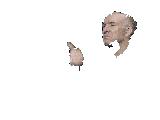
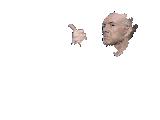


- Using Extracted Palms
- Affine Transform
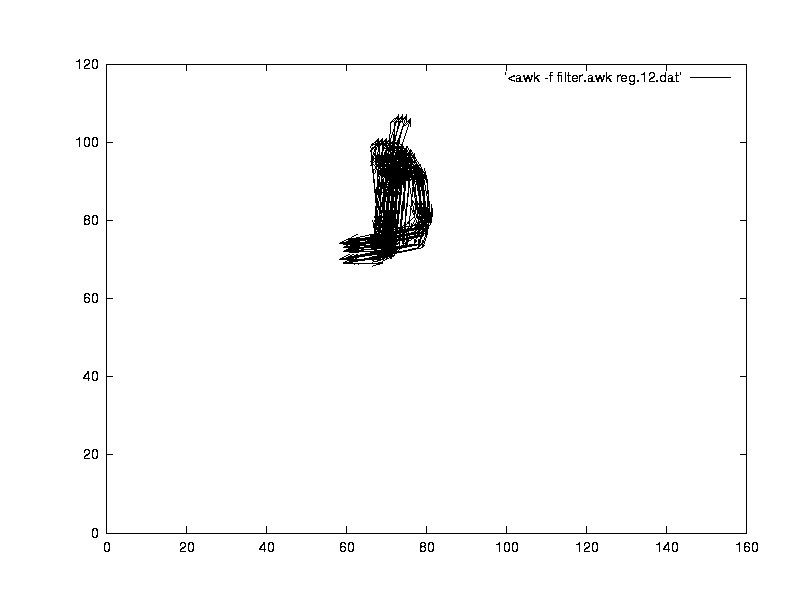
- Example: Motion Trajectory of Fingertip Region(20
frames)
- TDNN (Time-Delay Neural Network)
- ART (Adaptive Resonance Theory)
- HMM (Hidden Markov Model)
- Indexing Video Sequence Based on Spatio-Temporal Analysis
- Concept-Based Video Retrieval Based on Video Clip