|
Boaz Ilan's research webpage |
In general, my research lies at the interface of mathematics and real-world physical phenomena. It consists of modeling physical systems in terms of ordinary and partial differential equations and employing functional analysis, asymptotic and perturbation analysis, and numerical computations to analyze the models in detail. Much of my research is related to nonlinear waves. I am also studying optical systems that arise in solar science. These efforts are briefly described below and in my publications. The over-arching goal of my research is to connect between the mathematical and physical aspects arising from these problems and make reliable and useful predictions about physical systems.
When an intense laser beam propagates through matter it gives rise to an intensity dependent change of the refractive index, called the Kerr effect. This nonlinear phenomenon is responsible for the self-focusing of the beam. In some cases, diffraction can be perfectly balanced by self-focusing, giving rise to a soliton that propagates through the medium unscathed. This is utilized in mode-locked lasers that generate ultrashort pulses. The medium can be homogeneous, such as glass or crystal, or it may possess a complex (inhomogeneous) structure. For example, photonic crystal fibers can possess a lattice structure or even quasi-periodic structures, such as the "Penrose tile" (image below). These fibers and other complex media can guide light at wavelengths that are useful for spectroscopy, metrology and telecom.
When matter is cooled down near the absolute zero temperature, a large fraction of the atoms can collapse into the lowest allowable quantum state. This phenomenon, called Bose-Einstein condensation, was predicted in the 1920s and first realized experimentally in the 1990s. Bose-Einstein condensates (BECs) behave like quantum superfluids and have garnered much interest physics. Mathematically, a BEC can be described by the GP (defocusing NLS) equation. This equation admits dispersive shock waves that are characterized by an expanding oscillatory front. Dispersive shocks have also been observed in nonlinear optics. However, not much is known about multidimensional dispersive shocks. The animations below show solutions of the (2+1)D GP equation as an obstacle moves through a BEC. These solutions exhibit detached shocks, spontaneous creation of vortices, and the onset of turbulence among other phenomena. This is joint work with Mark Hoefer.
Additional resources: Self-focusing, Solitons, Mode-locking, Photonic crystal fibers, Bose-Einstein condensates, Dispersive shock waves,
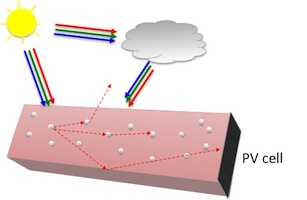
In a multi-disciplinary effort at UC Merced, highly-efficient LSCs based on semiconductor nanoparticles are being designed. Mathematically, this project entails analytical and computational modeling of the propagation, multiple absorption and reemission of light. We use Radiative Transport theory and Monte Carlo simulations of photon transport to predict the performance and optimal design parameters of such devices. The results help inform the synthesis efforts. This research is funded by the NSF (press release).
Current Ph.D. student: Derya Şahin
Additional resources: Luminescent solar concentrators, Radiative Transfer, Monte Carlo method for photon transport
Group Members
Derya Şahin (doctoral student)